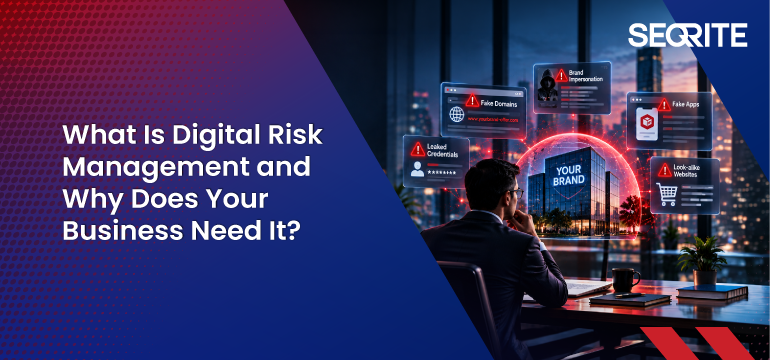

Digital transformation has changed the way businesses operate. Organisations now depend on cloud applications, digital platforms, connected devices, third-party vendors, social media, and online customer channels to deliver products and services. While these technologies create new growth opportunities, they also expand the organisation’s digital risk landscape.
A single exposed asset, compromised account, vulnerable application, leaked credential, or impersonating domain can create serious consequences for a business. The challenge is that many of these risks lie outside traditional security boundaries and may go unnoticed until they cause damage.
This is where digital risk management becomes important. It provides a broader approach to identifying, assessing, monitoring, and mitigating risks across an organisation’s digital ecosystem.
What Is Digital Risk Management?
Digital risk management is the process of identifying, assessing, monitoring, and mitigating risks that can affect an organisation’s digital assets, operations, reputation, and business continuity.
Traditional cybersecurity often focuses on protecting internal infrastructure, endpoints, networks, and applications. Digital risk management takes a wider view. It considers both internal and external digital risks, including threats across the surface web, deep web, dark web, social media, domains, third-party ecosystems, and exposed digital assets.
The objective is not simply to detect threats. It is to understand the organisation’s overall digital risk exposure and to take proactive steps to reduce it before it becomes a business problem.
An effective digital risk management approach typically involves:
- Digital asset discovery: Identifying domains, subdomains, IP addresses, applications, cloud assets, and other internet-facing assets.
- Risk assessment: Evaluating vulnerabilities, exposures, threats, and their potential business impact.
- Continuous monitoring: Tracking changes and emerging risks across the organisation’s digital footprint.
- Threat intelligence: Gathering actionable information about threats, compromised credentials, malicious infrastructure, and emerging attack campaigns.
- Incident response and mitigation: Taking appropriate action to contain or eliminate identified risks.
- Third-party risk monitoring: Assessing risks introduced through suppliers, partners, vendors, and other external entities.
- Brand and reputation protection: Detecting impersonation, fraudulent domains, fake profiles, and other activities that can damage customer trust.
In simple terms, digital risk management helps businesses answer three critical questions: What is exposed? What could go wrong? And what should we do about it?
Key Digital Risks Organizations Face Today
The modern digital environment creates risks that extend far beyond traditional cyberattacks. Some of the most significant risks include:
- Exposed Digital Assets
Organisations may have internet-facing assets that security teams are unaware of. Forgotten subdomains, outdated applications, exposed services, and misconfigured systems can provide attackers with potential entry points.
As organisations continuously add new digital assets, maintaining an accurate view of the external attack surface becomes increasingly difficult.
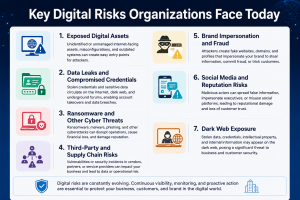
- Data Leaks and Compromised Credentials
Stolen usernames, passwords, API keys, and other credentials can appear on underground forums, dark web marketplaces, or other online sources. Attackers can use these credentials for account takeover, privilege escalation, data theft, or further attacks.
Monitoring for compromised credentials can help organisations identify potential exposure before attackers exploit it.
- Ransomware and Other Cyber Threats
Ransomware remains a major business risk because an attack can disrupt operations, encrypt critical data, and result in financial and reputational damage.
Digital risk management can complement internal security controls by helping organisations identify external indicators of compromise, exposed vulnerabilities, and threat activity associated with their digital environment.
- Third-Party and Supply Chain Risks
Businesses increasingly depend on vendors, service providers, technology partners, and cloud platforms. A security weakness at one of these organisations can potentially affect its customers and partners.
Third-party risk monitoring helps businesses gain better visibility into risks introduced through their extended digital ecosystem.
- Brand Impersonation and Fraud
Attackers can create fake websites, domains, social media profiles, and other digital identities that imitate legitimate businesses. These can be used for phishing, fraud, credential theft, or distribution of malicious content.
Beyond direct financial losses, such attacks can erode customer trust and damage brand reputation.
- Social Media and Reputation Risks
Social platforms can be exploited to impersonate employees or executives, distribute fraudulent content, or conduct social engineering campaigns.
Monitoring digital channels can help organisations detect suspicious activity associated with their brand and respond more quickly.
- Dark Web Exposure
The dark web can provide attackers with an environment to trade stolen credentials, corporate data, malware, and information about compromised organisations.
Without appropriate monitoring, businesses may not know that their information has appeared in these environments until it is used in an attack.
Check Your Digital Risk Score Now
How Digital Risk Management Helps Identify, Assess, and Mitigate Risks
The value of digital risk management lies in turning scattered risk signals into actionable intelligence.
- Identify: Discover What Is Exposed
The first step is gaining visibility into the organisation’s digital footprint.
Businesses need to identify known and unknown internet-facing assets, domains, applications, cloud resources, credentials, third-party connections, and other digital entities associated with the organisation.
Continuous discovery can reveal assets that may have been overlooked by conventional security processes.
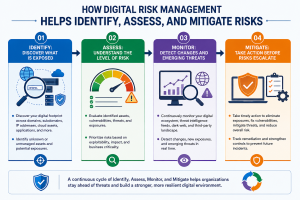
- Assess: Understand the Level of Risk
Not every digital exposure represents the same level of danger. Risk assessment helps organisations prioritise threats based on factors such as exploitability, business importance, data sensitivity, and potential impact.
For example, an exposed system containing sensitive business information may require immediate attention, while a low-risk configuration issue may be addressed through routine remediation.
This risk-based approach allows security teams to focus their resources where they can have the greatest impact.
- Monitor: Detect Changes and Emerging Threats
Digital risk is constantly changing. New domains are registered, vulnerabilities are discovered, credentials are leaked, and threat actors change their tactics.
Continuous monitoring enables organisations to identify these changes rather than relying on periodic assessments.
Real-time or near-real-time alerts can help security teams respond to critical exposures faster.
- Mitigate: Take Action Before Risks Escalate
Detection is only useful when it leads to action. Digital risk management supports mitigation by helping organisations remove exposed assets, secure compromised accounts, patch vulnerabilities, take down fraudulent domains, address third-party risks, and respond to emerging threats.
The result is a proactive security approach rather than waiting for an incident to reveal a weakness.
Why Digital Risk Management Is Essential for Business Resilience and Growth
Digital risk is no longer solely an IT concern. It can directly influence business continuity, customer trust, regulatory compliance, revenue, and brand reputation.
- Improve Business Resilience
Organisations that understand their digital exposure are better positioned to prepare for and respond to cyber incidents. Early identification of risks can reduce the likelihood and potential impact of disruptive attacks.
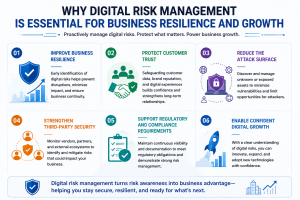
- Protect Customer Trust
Customers expect organisations to protect their information and maintain secure digital experiences. Detecting fraudulent websites, impersonation attempts, and data exposure can help businesses protect their reputation and strengthen customer confidence.
- Reduce the Attack Surface
You cannot protect what you cannot see. Digital risk management provides greater visibility into external assets and potential exposures, helping organisations continuously reduce their attack surface.
- Strengthen Third-Party Security
As businesses become more interconnected, understanding the security posture of vendors and partners becomes increasingly important. Digital risk management helps organisations monitor external dependencies and identify potential risks across the broader ecosystem.
- Support Regulatory and Compliance Requirements
Privacy and cybersecurity regulations increasingly emphasise appropriate security measures, risk management, and risk protection of personal and business data. A structured approach to digital risk can support organisations in demonstrating stronger security governance and risk awareness.
- Enable Confident Digital Growth
Digital transformation should not mean accepting uncontrolled risk. With continuous visibility and proactive risk mitigation, organisations can adopt new technologies, expand digital services, and enter new markets with greater confidence.
Building a Proactive Approach to Digital Risk
Digital risk cannot be managed through a one-time assessment. The digital environment changes continuously, and new threats can emerge at any time.
Businesses should therefore consider digital risk management as an ongoing process:
Discover → Assess → Monitor → Prioritise → Mitigate → Continuously Monitor
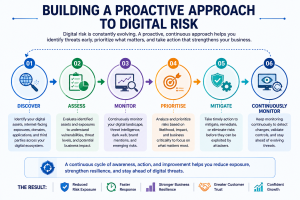
This approach helps organisations move from reactive cybersecurity to proactive digital risk management.
The goal is not to eliminate every possible risk—that is rarely realistic. Instead, organisations should understand where their most significant exposures exist, determine which risks could have the greatest business impact, and take timely action to reduce them.
Conclusion
The modern business environment extends far beyond the traditional corporate network. Organisations have digital assets, online identities, third-party relationships, customer-facing platforms, and data distributed across an increasingly complex ecosystem.
This expanded digital footprint creates new opportunities for attackers—and new challenges for security teams.
Digital risk management provides a proactive way to identify, assess, monitor, and mitigate these risks. By gaining continuous visibility into their digital environment, organisations can reduce exposure, protect their brands and customers, strengthen resilience, and support sustainable digital growth.
With Seqrite Digital Risk Protection Services (DRPS), organisations can strengthen this approach through continuous monitoring of their digital ecosystem. From identifying exposed assets and monitoring the surface, deep, and dark web to detecting brand impersonation, third-party risks, and other digital threats, Seqrite DRPS helps businesses gain actionable visibility into their evolving digital risk landscape.
In an environment where new digital risks can emerge every day, knowing what is exposed—and acting before attackers do—can make a significant difference.
Frequently Asked Questions
1. What is digital risk management?
Digital risk management is the process of identifying, assessing, monitoring, and mitigating risks associated with an organisation’s digital assets, online presence, technology infrastructure, third parties, and digital ecosystem.
2. Why is digital risk management important for businesses?
Digital risk management helps businesses identify potential threats before they cause damage. It can reduce the attack surface, protect sensitive information, safeguard brand reputation, strengthen business resilience, and support secure digital growth.
3. What are the common types of digital risks?
Common digital risks include exposed assets, compromised credentials, data leaks, ransomware, vulnerabilities, third-party risks, brand impersonation, fraudulent domains, social media threats, and dark web exposure.
4. How does digital risk management work?
Digital risk management typically involves discovering digital assets, assessing their risk, continuously monitoring for threats and exposures, prioritising critical risks, and taking appropriate mitigation measures.
5. What is the difference between cybersecurity and digital risk management?
Cybersecurity primarily focuses on protecting systems, networks, applications, devices, and data from cyber threats. Digital risk management takes a broader approach by also monitoring external digital risks such as brand impersonation, exposed assets, third-party risks, compromised credentials, and dark web activity.
6. How does digital risk management help reduce an organisation’s attack surface?
It helps organisations discover known and unknown internet-facing assets, identify vulnerabilities and exposures, and prioritise risks that could be exploited by attackers. Continuous monitoring also helps detect newly exposed assets and emerging threats.
7. Can digital risk management help protect a company’s brand?
Yes. Digital risk management can help detect fraudulent websites, lookalike domains, fake social media profiles, impersonation attempts, and other online activities that may be used to defraud customers or damage a company’s reputation.
8. How can Seqrite DRPS help with digital risk management?
Seqrite Digital Risk Protection Services (DRPS) helps organisations monitor and manage risks across their digital ecosystem. It provides capabilities such as digital asset monitoring, surface/deep/dark web monitoring, third-party risk monitoring, brand protection, social media surveillance, threat intelligence, and takedown services to help organisations identify and respond to digital risks proactively.