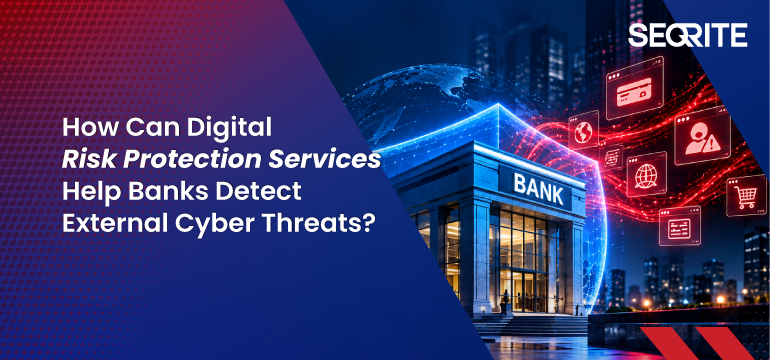

Banks have invested heavily in securing their internal IT infrastructure, endpoints, applications, and networks. However, cyber risks do not always originate inside the organisation. Attackers increasingly target a bank’s external digital presence, including websites, domains, social media accounts, mobile applications, employees, customers, and exposed credentials.
A compromised domain, fake banking website, impersonated social media account, or leaked employee credential can become the starting point for phishing, fraud, brand abuse, or a larger cyberattack.
This is where digital risk protection services for banks can help. These services continuously monitor the digital environment outside the bank’s traditional security perimeter, identify potential threats, and help security teams take action before those threats cause significant damage.
What digital risks can banks face outside their internal infrastructure?
A bank’s digital footprint extends far beyond its corporate network. Every public-facing asset, online mention, employee profile, customer interaction, and third-party digital service can potentially introduce risk.
Some of the key external digital risks banks can face include:
Fake websites and phishing domains
Attackers can register domains that closely resemble a bank’s legitimate website and use them to distribute phishing pages, collect login credentials, or deceive customers.
For example, a fraudulent domain may use a bank’s name with minor spelling changes, making it difficult for customers to distinguish it from the legitimate website.
Brand and executive impersonation
Cybercriminals may create fake social media profiles or websites impersonating a bank, its executives, or senior employees. These accounts can be used to build trust with customers before attempting fraud or spreading malicious content.
Exposed credentials
Employee or customer credentials can appear on underground forums, data-leak platforms, paste sites, or other parts of the internet. When exposed credentials remain active, attackers may attempt account takeover or use them as part of broader attacks.
Malicious or fake mobile applications
Fraudulent applications that imitate a bank’s legitimate mobile app can trick customers into sharing credentials, OTPs, financial information, or other sensitive data.
Typosquatting and cybersquatting
Attackers may register domains that are visually or typographically similar to a bank’s legitimate domain. These domains can be used for phishing, malware distribution, advertising fraud, or brand abuse.
Dark-web exposure
Information associated with a bank, its employees, customers, or digital assets may surface on underground communities and dark-web sources. Monitoring these sources can help security teams identify potential exposure earlier.
Third-party and supply-chain risks
Banks rely on technology providers, partners, service providers, and other external organisations. Security weaknesses or exposed information associated with these third parties can create additional risks for the bank.
How do digital risk protection services monitor threats targeting banks?
Traditional security controls generally focus on assets that the organisation owns or controls. External digital risk protection takes a broader approach by monitoring the digital environment surrounding the organisation.
Digital risk protection services can continuously monitor multiple sources across the surface, deep, and dark web to identify potential threats associated with a bank’s digital footprint.
1. Discovering external digital assets
The first step is understanding what is exposed outside the bank’s controlled environment.
Digital risk protection platforms can identify domains, subdomains, applications, social media profiles, digital assets, and other online properties associated with the organisation.
This helps security teams build a clearer picture of their external attack surface.
2. Monitoring the web for potential threats
The service can continuously monitor publicly available websites, social platforms, domain registrations, marketplaces, forums, and other online sources for suspicious activity.
Monitoring can identify potential brand abuse, phishing infrastructure, impersonation attempts, and other threats linked to the bank.
3. Monitoring underground and dark-web sources
External monitoring can also extend to underground sources where compromised credentials, stolen information, and discussions related to targeted organisations may appear.
This provides security teams with visibility into risks that may not be detected through conventional security tools.
4. Identifying suspicious activity
Once potential threats are discovered, they can be assessed based on factors such as the affected asset, threat type, similarity to legitimate assets, and potential impact.
This helps security teams prioritise the threats that require immediate attention.
5. Supporting response and takedown
Detection is only one part of external digital risk protection. Depending on the service, organisations can also receive assistance with reporting and taking down malicious domains, fake websites, impersonating accounts, and other fraudulent assets.
This can reduce the time between discovering an external threat and taking action against it.
Which digital risks can banks detect and respond to?
A comprehensive external digital risk protection strategy can help banks identify several categories of threats.
| Digital risk | Potential impact on banks |
|---|---|
| Phishing websites | Credential theft and customer fraud |
| Fake domains | Brand abuse and phishing |
| Typosquatting | Customer redirection and impersonation |
| Fake social media profiles | Fraud and reputation damage |
| Executive impersonation | Social engineering and financial fraud |
| Fake mobile applications | Theft of credentials and sensitive information |
| Leaked credentials | Account takeover and unauthorised access |
| Dark-web exposure | Early warning of compromised information |
| Data leaks | Privacy, regulatory, and reputational risks |
| Malicious advertisements | Customer redirection and fraud |
| Third-party digital risks | Increased exposure through external partners |
For banks, the ability to connect these individual signals is particularly important. A suspicious domain, leaked credential, and fake social media profile may initially appear to be separate incidents. Together, they could indicate a coordinated campaign targeting the organisation or its customers.
How can banks strengthen their external digital risk protection?
Banks can strengthen their external security posture by treating their digital footprint as an extension of their security perimeter.
Maintain continuous external monitoring
External assets and threats change constantly. Banks should continuously monitor their domains, brands, executives, applications, social media presence, and other digital assets rather than relying only on periodic assessments.
Monitor for leaked credentials
Monitoring for exposed employee and organisational credentials can provide early warning that attackers may have access to information that could be used in future attacks.
Protect high-risk individuals
Executives and other high-profile employees can become targets for impersonation and social engineering. Monitoring their digital presence can help identify fraudulent profiles and impersonation attempts.
Detect threats before customers are affected
The earlier a fake website, domain, or social media account is identified, the sooner the bank can investigate and initiate appropriate response measures.
Integrate external intelligence with security operations
External digital risk findings become more valuable when security teams can correlate them with internal security events, threat intelligence, and incident-response processes.
Establish a response and takedown process
Banks should have a defined process for validating external threats, escalating incidents, notifying relevant stakeholders, and taking down malicious digital assets where possible.
Protecting the bank beyond the traditional security perimeter
Cybersecurity for banks can no longer stop at the firewall. Attackers can exploit digital assets, impersonate trusted brands, expose credentials, and target customers without ever directly penetrating the bank’s internal infrastructure.
Digital risk protection services for banks provide visibility into this external threat landscape by continuously monitoring digital assets and online sources, identifying potential threats, and supporting timely response.
For financial institutions, this approach can help transform external digital risk from a blind spot into a monitored part of the overall security strategy.
Seqrite Digital Risk Protection Services (DRPS) helps organisations monitor their external digital footprint, identify threats such as phishing, impersonation, fake domains, exposed credentials, and other forms of digital risk, and take action to reduce their exposure.