
An organization’s digital footprint no longer ends at its network perimeter. Brands operate across websites, social media, cloud platforms, mobile apps, third-party ecosystems, code repositories, and countless other external channels. At the same time, cybercriminals are using these environments to launch phishing attacks, impersonate brands, expose credentials, distribute fake applications, and trade stolen information.
This expanding attack surface has made Digital Risk Protection Services (DRPS) an increasingly important part of enterprise cybersecurity.
The best digital risk protection services in 2026 go beyond simply finding threats. They continuously monitor an organization’s external digital footprint, identify risks across the surface, deep, and dark web, prioritize threats, and support rapid remediation or takedown.
But with different DRPS providers offering different capabilities, how should businesses determine which service is right for them?
What Do Digital Risk Protection Services Help Businesses Protect?
Digital risk protection focuses on threats that originate or exist outside an organization’s traditional security perimeter.
While endpoint and network security solutions protect internal systems and devices, DRPS extends visibility into external environments where attackers may be targeting an organization without directly interacting with its infrastructure.
A comprehensive DRPS service can help protect:
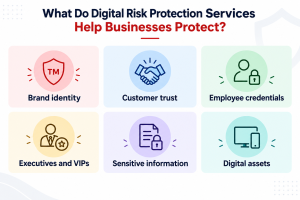
Brand identity: Cybercriminals frequently create lookalike domains, fake websites, fraudulent social media accounts, and malicious advertisements that imitate trusted brands.
Customer trust: Fake websites, phishing campaigns, and fraudulent mobile applications can trick customers into sharing credentials, financial information, or other sensitive data.
Employee credentials: Credentials exposed through breaches, malware, credential-stealing campaigns, or underground marketplaces can provide attackers with opportunities to access corporate systems.
Executives and VIPs: Senior executives can be targeted through impersonation, fake profiles, social engineering, and information exposed across digital channels.
Sensitive information: Confidential documents, credentials, API keys, source code, and other sensitive information may appear on dark web forums, paste sites, repositories, or other external platforms.
Digital assets: Domains, subdomains, IP addresses, cloud assets, and other internet-facing infrastructure can create security risks when they are unknown, misconfigured, or vulnerable.
This makes DRPS particularly useful for organizations with large digital footprints, recognizable brands, extensive customer interactions, or significant exposure to third-party ecosystems.
Which DRPS Capabilities Should Organizations Compare?
Not every digital risk protection service provides the same depth of monitoring or response. Organizations evaluating DRPS solutions in 2026 should compare capabilities rather than looking at threat alerts alone.
Surface, Deep, and Dark Web Monitoring
A strong DRPS platform should continuously monitor multiple layers of the internet. This can include websites, forums, marketplaces, paste sites, underground communities, and other sources where organizational information or threats may appear.
Broader visibility improves the chances of identifying risks before they escalate.
Brand and Domain Protection
Organizations should look for capabilities that detect:
- Lookalike and typosquatted domains
- Fake websites
- Phishing pages
- Fraudulent social media accounts
- Fake mobile applications
- Unauthorized use of brand identities
Early identification can help organizations reduce the time attackers have to exploit customers or employees.
Credential and Data Leak Monitoring
Compromised credentials are particularly valuable to attackers.
DRPS should therefore be capable of detecting leaked usernames, passwords, email addresses, confidential information, API keys, secrets, and other exposed organizational data across relevant external sources.
Executive and VIP Monitoring
Executives and other high-profile employees can become targets for impersonation, phishing, fraud, and social engineering.
Monitoring executive names, identities, fake accounts, and related exposure helps security teams identify targeted campaigns earlier.
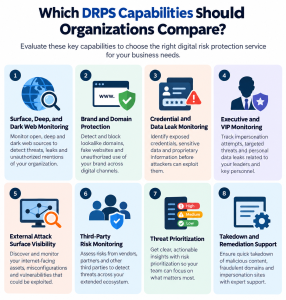
External Attack Surface Visibility
Organizations cannot protect digital assets they do not know exist.
DRPS platforms with external attack surface capabilities can help identify exposed domains, subdomains, services, and other internet-facing assets that may introduce risk.
Third-Party Risk Monitoring
An organization’s digital risk can also originate from vendors, suppliers, technology partners, and other third parties.
Monitoring external indicators associated with critical partners can provide additional visibility into risks that may indirectly affect the organization.
Threat Prioritization
More alerts do not necessarily mean better security.
An effective DRPS service should provide context and severity-based prioritization so security teams can distinguish genuine threats from low-risk findings and focus resources where they matter most.
Takedown and Remediation Support
Detection is only the first step.
Organizations should consider whether the DRPS provider offers support for removing malicious domains, phishing pages, fake profiles, fraudulent applications, and other impersonation infrastructure.
The ability to move from detection to disruption can significantly improve the practical value of DRPS.
How Do Leading Digital Risk Protection Services Detect External Threats?
Leading DRPS solutions typically combine automated discovery technologies, threat intelligence, analytics, and human expertise.
The process usually begins by establishing the organization’s digital footprint. This can include brand names, domains, executives, products, applications, email domains, subsidiaries, and other assets that attackers might exploit.
The DRPS platform then continuously searches relevant external environments for suspicious activity.
For example, it may identify a newly registered domain that closely resembles the company’s legitimate domain. It could detect employee credentials appearing in an underground source, discover a fake social media account impersonating an executive, or identify confidential information exposed in a public code repository.
Advanced platforms use technologies such as machine learning, pattern recognition, domain similarity analysis, threat intelligence, and automated correlation to process large volumes of external data.
Human threat researchers can add another layer of context by validating findings, investigating suspicious activity, and determining whether an identified exposure represents a genuine threat.
This combination of continuous monitoring, automated analysis, threat intelligence, and expert validation allows businesses to detect external risks that conventional internal security tools may not see.
How Can Businesses Choose a DRPS Service Based on Their Security Needs?
There is no single DRPS service that will be the best choice for every organization. The right service depends on the company’s digital footprint, threat profile, industry, regulatory requirements, and existing security architecture.
A BFSI organization, for example, may prioritize phishing detection, fake domains, credential exposure, dark web monitoring, executive impersonation, and rapid takedowns.
An e-commerce or retail organization may place greater emphasis on brand impersonation, fraudulent websites, fake applications, social media abuse, and customer-facing scams.
Large enterprises with complex infrastructure may need stronger external attack surface management and third-party risk visibility.
Organizations should therefore begin by identifying their most important external digital risks.
They should then evaluate DRPS providers based on the breadth of monitoring sources, detection capabilities, threat intelligence, contextual analysis, alert prioritization, dashboard visibility, integration options, reporting, takedown capabilities, and access to security experts.
Another important consideration is actionability.
A DRPS platform that generates hundreds of alerts without sufficient context can increase workload for already stretched security teams. Organizations should look for services that help them understand:
What happened? Who or what is being targeted? How serious is the threat? What action should be taken next?
Ultimately, the best DRPS service is not necessarily the one monitoring the largest number of sources. It is the one that turns external threat intelligence into timely and meaningful security action.
Conclusion: Choosing the Right Digital Risk Protection Service in 2026
As organizations expand their digital presence, attackers are expanding theirs too. Fake domains, phishing websites, exposed credentials, dark web activity, executive impersonation, data leaks, and other external threats can develop beyond the visibility of traditional security controls.
Digital Risk Protection Services help close this visibility gap.
When comparing DRPS providers in 2026, businesses should prioritize comprehensive external monitoring, brand protection, dark web intelligence, credential leak detection, executive monitoring, attack surface visibility, contextual threat prioritization, and effective takedown capabilities.
Most importantly, DRPS should help an organization move from discovering external threats to disrupting them before they cause greater damage.
Take control of your external digital risk with Seqrite DRPS. Seqrite Digital Risk Protection Services help organizations continuously monitor threats across the surface, deep, and dark web, identify brand impersonation, phishing domains, exposed credentials, data leaks, executive risks, and other digital threats, and support timely takedown and remediation. Discover how Seqrite DRPS can help protect your brand, customers, and digital ecosystem from threats beyond the traditional security perimeter. Explore Seqrite DRPS and strengthen your external threat defense today.