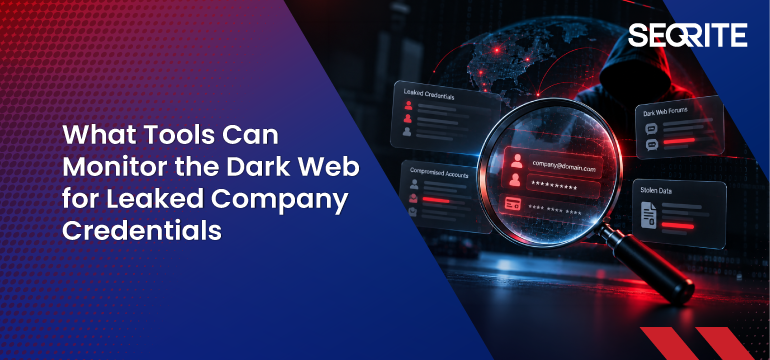

A corporate username and password can open the door to an entire organization. When credentials are stolen through phishing, malware, data breaches, or compromised third parties, they may eventually appear in places where cybercriminals trade and exchange stolen information, including the dark web.
The challenge for businesses is that these credentials can remain exposed without the security team knowing. Attackers may use them for account takeover, unauthorized access, business email compromise, ransomware attacks, or further reconnaissance against the organization.
This is where dark web monitoring tools become important. They continuously search underground sources for exposed corporate information and help security teams identify compromised credentials before attackers can exploit them.
What Is Dark Web Monitoring?
Dark web monitoring is the process of continuously scanning hidden and underground areas of the internet for information associated with an organization.
Unlike conventional search engines, which index publicly accessible websites, dark web monitoring solutions look across sources that may not be easily accessible through standard browsers or search engines. Depending on the solution, monitoring can cover dark web marketplaces, underground forums, paste sites, breach repositories, messaging channels, and other sources where stolen information may circulate.
Organizations can monitor for information such as:
- Employee email addresses and passwords
- Corporate domains and subdomains
- Login credentials
- Customer or employee information
- API keys and authentication tokens
- Confidential documents
- Intellectual property
- Database records
- Information related to executives and other high-value individuals
Advanced monitoring platforms go beyond simply finding mentions. They collect and analyze threat data, correlate findings with an organization’s digital assets, prioritize exposures based on severity, and generate alerts that security teams can investigate.
This gives businesses an opportunity to act on exposed information before it leads to a larger security incident.
How Do Company Credentials End Up on the Dark Web?
Corporate credentials can be exposed through several attack paths. Importantly, an organization’s infrastructure does not always need to be directly breached for employee credentials to become compromised.
1. Phishing Attacks
Attackers frequently create fake login pages designed to imitate Microsoft 365, Google Workspace, VPN portals, banking services, or corporate applications.
Employees who enter their credentials into these pages may unknowingly hand their usernames and passwords directly to attackers.
2. Infostealer Malware
Information-stealing malware can collect passwords, browser cookies, session tokens, cryptocurrency wallet information, and other sensitive data from infected devices.
The stolen information may be packaged into stealer logs and sold or distributed within cybercriminal communities. If an employee accesses business systems from an infected device, corporate credentials can become part of these datasets.
3. Third-Party Data Breaches
Organizations increasingly depend on SaaS providers, vendors, contractors, and other third parties.
If one of these organizations suffers a breach, corporate email addresses, passwords, or other information belonging to employees of the customer organization may also be exposed.
4. Password Reuse
An employee may use the same or similar password for both personal and professional accounts.
If a personal service is breached, attackers can test the exposed email-password combination against corporate services through credential-stuffing attacks.
5. Misconfigured Systems and Data Exposure
Cloud storage, databases, development environments, and repositories that are accidentally exposed can reveal credentials, API keys, access tokens, and other secrets.
Once discovered, this information may be shared or sold across underground cybercrime ecosystems.
Risks of Leaked Credentials for Businesses
A leaked password might initially appear to be an isolated security issue. In practice, it can provide attackers with the foothold needed for a much broader compromise.
Account takeover: Attackers may use valid credentials to access corporate email, cloud platforms, VPNs, SaaS applications, or internal systems.
Business Email Compromise (BEC): Access to an employee’s mailbox can allow attackers to impersonate employees, manipulate payment requests, intercept conversations, or target customers and suppliers.
Privilege escalation: A compromised account may provide attackers with opportunities to move deeper into the organization’s environment and gain additional privileges.
Ransomware: Stolen credentials are frequently valuable during the early stages of an intrusion because they can help attackers bypass traditional perimeter defenses and establish access.
Data theft: Once inside corporate systems, attackers may steal sensitive customer information, financial records, intellectual property, or confidential business documents.
Brand and reputational damage: Compromised accounts can also be used to target customers and partners, potentially damaging trust in the organization’s brand.
The risk becomes even greater when compromised credentials remain valid for extended periods. This makes early detection and rapid remediation critical.
Features to Look for in Dark Web Monitoring Tools
Not every dark web monitoring platform offers the same level of visibility. Organizations evaluating tools should consider both the breadth of monitoring and the platform’s ability to convert threat intelligence into actionable alerts.
- Broad Source Coverage
A monitoring solution should provide visibility across multiple external sources rather than relying on a narrow collection of known breach databases.
Coverage may include dark web forums and marketplaces, breach repositories, paste sites, credential dumps, underground communities, and relevant messaging channels.
- Credential Leak Detection
The platform should continuously identify exposed corporate email addresses, usernames, passwords, and other authentication information associated with the organization’s domains.
- Real-Time or Rapid Alerts
Speed matters when credentials are compromised. Security teams should receive alerts quickly enough to reset passwords, revoke sessions, disable affected accounts, or investigate suspicious activity before the credentials are exploited.
- Context and Risk Prioritization
Finding thousands of exposed records without context can overwhelm security teams.
Effective platforms should help determine which findings pose the greatest risk based on factors such as credential validity, employee role, source, exposure recency, and the sensitivity of the affected asset.
- Executive and VIP Monitoring
Senior executives and other high-profile employees are attractive targets for phishing, impersonation, fraud, and account takeover.
Monitoring their digital exposure can help organizations identify targeted threats before they escalate.
- Monitoring Beyond the Dark Web
Credential exposure does not happen exclusively on the dark web. Organizations should consider solutions that also monitor the surface web, deep web, code repositories, fake domains, social platforms, and other external sources.
This provides a broader picture of the organization’s external digital risk.
- Integration with Security Operations
Dark web intelligence becomes more useful when it can feed into existing security workflows. Integrations with SIEM, SOAR, threat intelligence, identity, and incident-response systems can help teams investigate and remediate exposures faster.
What Tools Can Businesses Use?
Organizations generally have several options for monitoring leaked credentials.
Standalone dark web monitoring services can identify corporate information appearing in known breach datasets and underground sources. Threat intelligence platforms can provide deeper information about threat actors, campaigns, malware, and compromised infrastructure. Digital Risk Protection Services (DRPS) can provide broader monitoring by connecting credential exposure with other external threats such as phishing domains, brand impersonation, data leakage, fake profiles, and attack-surface risks.
For enterprises, this broader context is increasingly important. A leaked credential may not be an isolated incident—it could be connected to an infostealer infection, phishing campaign, impersonation attempt, or planned attack against the organization.
Solutions such as Seqrite Digital Risk Protection Services (DRPS) help organizations gain visibility into risks beyond their traditional security perimeter. By monitoring the surface, deep, and dark web, organizations can identify exposed credentials, data leaks, brand abuse, phishing activity, and other external digital threats from a unified risk perspective.
Best Practices for Responding to Exposed Credentials
Detecting compromised credentials is only the beginning. Organizations need a defined response process to reduce the likelihood that exposed credentials will turn into a security incident.
Immediately reset compromised passwords. Require the affected user to create a new, unique password and ensure the exposed password is not being reused across other corporate accounts.
Revoke active sessions and tokens. Changing a password alone may not always terminate an attacker’s existing authenticated session. Review and revoke active sessions, refresh tokens, and other authentication artifacts where appropriate.
Enforce multi-factor authentication. MFA adds an important security layer if passwords become compromised. Organizations should prioritize phishing-resistant authentication methods for sensitive and privileged accounts wherever possible.
Investigate the source of exposure. Determine whether the credential originated from phishing, malware, a third-party breach, password reuse, or another compromise. If infostealer malware is suspected, resetting the password without addressing the infected endpoint may leave the organization exposed.
Review account activity. Examine login history, IP addresses, device information, mailbox rules, privilege changes, and other indicators for signs that the exposed credentials have already been used.
Prioritize privileged accounts. Credentials associated with administrators, executives, finance teams, developers, and other high-value users should receive immediate attention.
Strengthen employee awareness. Regular phishing simulations and security-awareness programs can help employees recognize credential-harvesting attempts and risky password practices.
Continuously monitor for re-exposure. Credential monitoring should not be treated as a one-time exercise. New breaches, malware infections, and credential dumps appear continuously, making ongoing monitoring essential.
Turn Dark Web Exposure Into Actionable Intelligence
Organizations cannot prevent stolen information from appearing in every corner of the internet. But they can improve how quickly they discover and respond to it.
Dark web monitoring gives security teams visibility into compromised credentials that may otherwise remain unnoticed until an attack occurs. When combined with broader digital risk protection, organizations can connect credential leaks with phishing, impersonation, data exposure, and other external threats.
Seqrite Digital Risk Protection Services (DRPS) helps enterprises continuously monitor their external digital footprint across the surface, deep, and dark web. From exposed credentials and data leaks to phishing domains, brand impersonation, and external attack-surface risks, Seqrite DRPS helps security teams identify, prioritize, and respond to digital threats before they can cause greater damage.
Discover your external digital risks before attackers exploit them with Seqrite DRPS.