
Your firewall held. Your SOC stayed quiet. And a customer still lost money to a company that looked exactly like yours.
Picture a Monday morning. A long-time customer calls your helpline, upset. Over the weekend she paid to “renew” her account on your website. It had your logo, your colours, your tone of voice. She even got a confirmation SMS. None of it was yours.
Your security team checks the dashboards. There are no alerts, no suspicious logins, and no malware. By every internal measure, nothing happened.
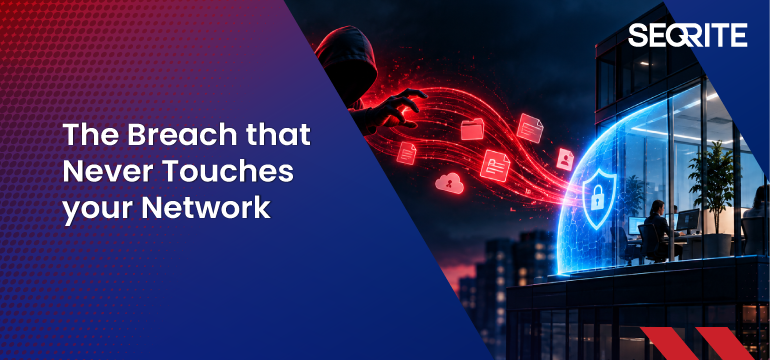
That’s the problem. The fraud was real, the loss was real, and your brand was the bait. It just never touched your network.
The perimeter moved. Most security strategies didn’t.
For years, we’ve built security around the things we own: endpoints, servers, networks, and cloud workloads. Attackers noticed. More and more, they operate in places we don’t own and rarely watch, such as domain registrars, app stores, WhatsApp groups, social media, and dark web marketplaces.
The scale is hard to ignore. APWG recorded 971,181 phishing attacks in the first quarter of 2026, a 13.8% rise over the previous quarter (Source: APWG Phishing Activity Trends Report, Q1 2026). That works out to roughly one every eight seconds. The same report found that threat volume went up on every social media platform tracked by ZeroFox, one of its contributors.
India is feeling this sharply. Indians lost at least ₹22,495 crore to cyber fraud in 2025, across 2.81 million reported cases (Source: Ministry of Home Affairs data, reported by ThePrint, February 2026). Investment scams accounted for more than three-quarters of that money, and many of them run on borrowed credibility. SEBI has warned that fraudsters pull investors into fake “VIP” trading groups while posing as registered intermediaries, public figures and senior leaders of well-known firms (Source: SEBI press release, May 2025). The NSE has even issued public advisories naming brokerages whose representatives were being impersonated (Source: NSE press release, May 2024).
The victims in these cases never dealt with the real company. But ask them afterwards whose name they remember.
No malware, no intrusion, $25 million gone
If you want one story for your next board meeting, use this one. In early 2024, a finance employee at engineering firm Arup’s Hong Kong office joined a video call with what appeared to be the company’s CFO and other colleagues. Everyone on that call except him was a deepfake. He went on to make 15 transfers worth $25.6 million (Source: Fortune, May 2024).
Then comes the part worth remembering. Arup’s spokesperson later said that “none of our internal systems were compromised.” By the traditional definition of a breach, there wasn’t one. The money was still gone.
Your attack surface now includes your executives’ faces and voices, your brand’s look and feel, and the trust people place in both.
Leaked credentials are a countdown
This outside-in view matters for classic attacks too. The Verizon 2026 Data Breach Investigations Report found that 73% of ransomware victims had an infostealer infection or a credential leak in the year before the attack, and for half of them, the leak surfaced within 95 days of it (Source: Verizon 2026 DBIR).
Read that as a leader. The warning sign often appears outside your walls, in a stealer log or a dark web listing, months before the ransomware does. If nobody is watching for it, you’ve given the attacker a three-month head start.
So whose problem is it?
This is where most organisations get stuck. Marketing owns the brand. Legal owns the trademarks. The fraud team owns customer losses. Customer care takes the angry calls. Security owns the network.
So when a fake app shows up on a third-party store at 11 pm on a Saturday, who files the takedown? Who decides whether to warn customers? In too many companies, the honest answer is whoever notices first. Usually, that’s a customer.
The cost of this gap is quieter than you might expect. In a survey of 1,029 US adults published in September 2026, just 4.2% of people whose trusted brand had been impersonated held that brand responsible. Yet 30.2% said they would stop buying from it online altogether, and 31.6% said they would stop clicking its ads (Source: BrandShield 2026 Consumer Fraud and Trust Report). Customers may not blame you. They simply leave.
Regulators have noticed. The RBI directed banks to move to an exclusive .bank.in domain by 31 October 2025 so customers could tell genuine banking sites from fakes, and more than 400 banks have since migrated (Source: RBI circular RBI/2025-26/28; The Paypers). Most businesses don’t have a verified domain like that. Their customers are still guessing.
What good looks like
Closing this gap starts with a few leadership decisions.
Give it one owner. External digital risk should sit clearly with one leader, usually the CISO, with defined roles for marketing, legal, fraud, and customer care. Agree in advance who can approve a takedown or a public advisory, so no one is hunting for sign-off at midnight.
Watch the outside continuously. Lookalike domains, cloned apps, fake social profiles and leaked credentials deserve the same attention as your endpoints. A leaked credential should be treated as an incident, with remediation that goes beyond a password reset to cover everything the attacker may have taken.
Measure time to takedown. Here, the metric that matters most is how long a fake site or app stays live after it first appears. Every hour it’s up is another hour a customer can be defrauded.
Verify out of band. Make it normal for anyone to confirm payment requests through a second, known channel, however convincing the call or message looks. It’s the cheapest control you’ll ever put in place.
Rehearse the customer side. Run tabletop exercises for impersonation, not just ransomware. Who drafts the customer advisory? What does the helpline tell callers? How do you guide victims to report quickly through the national 1930 cyber fraud helpline?
Where Seqrite fits
This outside-the-perimeter gap is what Seqrite Digital Risk Protection Services (DRPS) was built to close. It monitors the surface, deep and dark web around the clock, flags lookalike domains, fake profiles and malicious apps, tracks exposed credentials, and backs this up with a dedicated war room for takedowns, legal escalations, and crisis management. If you want to know what your organisation’s external exposure looks like today, Seqrite’s experts can run an evaluation for you.
The bottom line
Security used to mean protecting what sat inside your walls. Today it also means protecting what people believe is you. The next breach that hurts your business may never appear on a dashboard. It’ll appear in your customer care queue. The real question is whether you find it before your customers do.
References
- APWG, Phishing Activity Trends Report, Q1 2026: https://docs.apwg.org/reports/apwg_trends_report_q1_2026.pdf
- Verizon, 2026 Data Breach Investigations Report: https://www.verizon.com/business/resources/reports/dbir/
- ThePrint, report on Ministry of Home Affairs cyber fraud data for 2025 (February 2026): https://theprint.in/india/cybercrime-saw-24-spike-in-2025-indians-lost-rs-22495-crore-mainly-in-investment-scams/2859930/
- SEBI advisory on fake trading groups on social media, as covered by Angel One (May 2025): https://www.angelone.in/news/sebi-warns-investors-against-fake-trading-groups-on-whatsapp-and-other-social-media-platforms
- NSE press release cautioning investors about people impersonating brokers’ representatives (May 2024): https://nsearchives.nseindia.com/web/sites/default/files/2024-06/PR_cc_29052024.pdf
- Fortune, report on the Arup deepfake fraud (May 2024): https://fortune.com/europe/2024/05/17/arup-deepfake-fraud-scam-victim-hong-kong-25-million-cfo
- BrandShield 2026 Consumer Fraud and Trust Report, as covered by The AI Journal (September 2026): https://aijourn.com/brandshield-study-finds-ai-scams-are-hurting-legitimate-brands/
- The Paypers, report on Indian banks’ migration to .bank.in under RBI circular RBI/2025-26/28: https://thepaypers.com/fraud-and-fincrime/news/over-400-indian-banks-migrate-to-bankin-domain
- Ministry of Home Affairs, Lok Sabha reply on cyber fraud reporting and the 1930 helpline (December 2025): https://www.mha.gov.in/MHA1/Par2017/pdfs/par2025-pdfs/LS02122025/432.pdf
- Seqrite Digital Risk Protection Services (DRPS): https://www.seqrite.com/drps/