
Malware can hide inside legitimate-looking files, exploit vulnerabilities, execute malicious scripts, or remain dormant until specific conditions are met.
For security teams, identifying a suspicious file is only the beginning. They also need to understand what it does, how dangerous it is, which systems it may affect, and what action to take.
A malware analysis platform helps answer these questions by examining suspicious files, URLs, scripts, and other potentially malicious artifacts. Using static and dynamic analysis, sandboxing, behavioral monitoring, and threat intelligence, these platforms help analysts understand malware without exposing production environments to unnecessary risk.
Why Do Security Teams Use Malware Analysis Platforms?
Security teams handle large volumes of suspicious files and alerts. Investigating every artifact manually can consume analyst time and delay responses to genuine threats.
Malware analysis platforms provide a controlled and repeatable way to investigate suspicious content.
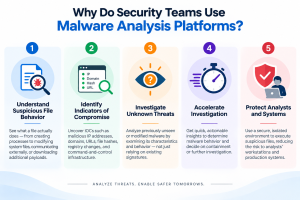
- Understand Suspicious File Behavior
A file that appears harmless may create processes, modify system files, establish persistence, communicate with external infrastructure, or download additional payloads after execution.
Dynamic analysis allows analysts to observe these activities inside an isolated environment instead of executing suspicious files on production endpoints.
- Identify Indicators of Compromise
Analysis can uncover indicators of compromise (IOCs) such as malicious IP addresses, domains, URLs, file hashes, registry modifications, dropped files, and command-and-control infrastructure.
Security teams can use these indicators for further investigation and threat hunting across their environments.
- Investigate Unknown Threats
Signature-based detection is effective against known malware, but attackers continuously modify their techniques.
Malware analysis platforms can investigate previously unseen or modified malware by examining characteristics and behavior instead of relying entirely on existing signatures.
- Accelerate Investigation
When an alert involves a suspicious executable, attachment, script, or downloaded file, malware analysis provides additional context. Analysts can determine how the artifact behaves and whether containment or further investigation is required.
- Protect Analysts and Systems
Executing potentially malicious software directly on an analyst workstation introduces unnecessary risk. Sandboxing provides an isolated environment where suspicious artifacts can be executed and monitored more safely.
Which Features Differentiate Effective Malware Analysis Platforms?
Security teams should prioritize capabilities that improve analysis quality, investigation speed, scalability, and integration with existing security operations.
- Static Analysis
Static analysis examines files without executing them. It can reveal hashes, headers, embedded strings, imported functions, metadata, certificates, packers, and other structural information.
This provides an initial understanding of an artifact before behavioral analysis begins.
- Dynamic Analysis and Sandboxing
Dynamic analysis executes suspicious content inside an isolated environment and observes its behavior, including:
- Process creation
- File and registry modifications
- Network connections and DNS requests
- Persistence mechanisms
- Payload downloads
- System configuration changes
- Command-and-control communication
This behavioral visibility is valuable when static characteristics alone cannot determine what a file does.
- Behavioral Analysis
Effective platforms should connect individual actions into meaningful behavioral sequences.
For example, rather than separately reporting process creation, registry modification, persistence, and outbound communication, the platform should help analysts understand how these activities relate to one another.
- Multiple File Types and Environments
Threats are not limited to executable files. Security teams may need to investigate Office documents, PDFs, scripts, archives, URLs, DLLs, installers, and other formats.
Support for multiple operating systems and execution environments can provide broader coverage.
- Anti-Evasion Capabilities
Advanced malware may detect virtual machines or sandboxes and alter its behavior or remain inactive. Malware analysis platforms therefore need capabilities designed to address common sandbox and virtual-machine evasion techniques.
- Threat Intelligence Enrichment
Analysis becomes more useful when findings are enriched with threat intelligence.
Hashes, domains, IP addresses, URLs, malware families, campaigns, and known attacker infrastructure can provide additional context and help analysts connect an artifact with broader threat activity.
- Automated Reporting and Integrations
Clear risk classifications, behavioral summaries, IOCs, and technical reports reduce the time analysts spend interpreting raw output.
API support and integrations with SIEM, SOAR, EDR, XDR, email security, threat intelligence, and incident response tools can also help operationalize analysis results.
How Do Malware Analysis Platforms Support Detection and Investigation?
The value of malware analysis extends beyond determining whether an individual file is malicious.
-Turn Artifacts Into Actionable Intelligence
Consider an endpoint alert involving an unfamiliar executable. Analysis may reveal that the file launches a suspicious process, establishes persistence, contacts an external domain, and downloads another payload.
Analysts can then use the resulting indicators and behavioral information to search for similar activity elsewhere.
-Improve Threat Hunting
Indicators discovered through malware analysis can become inputs for threat hunting.
Teams can search endpoints, network telemetry, logs, SIEM, or XDR data for related hashes, domains, IP addresses, processes, file paths, and behavioral patterns.
-Support Alert Triage
Automated analysis provides additional evidence for prioritization by helping distinguish artifacts demonstrating malicious behavior from those requiring less urgent investigation.
This enables analysts to focus their time on higher-risk activity.
-Support Incident Response
During an incident, malware analysis can help teams determine what the malware changes, whether it establishes persistence, what infrastructure it communicates with, whether it downloads additional payloads, and which indicators should be investigated elsewhere.
These findings can support containment, eradication, recovery, and threat hunting.
-Strengthen Detection
Indicators and behavioral patterns identified during malware analysis can also help teams develop or refine endpoint, network, SIEM, and XDR detection logic.
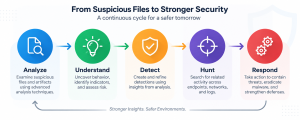
This creates a continuous cycle:
Analyze → Understand → Detect → Hunt → Respond
How Should Security Teams Evaluate a Malware Analysis Platform?
Choosing a platform should begin with actual security workflows rather than simply comparing feature lists.
1. Analysis Depth
Assess whether the platform provides the required combination of static, dynamic, behavioral, and network analysis.
The required depth will vary depending on whether the platform is used for basic file triage, SOC investigations, threat research, or advanced malware analysis.
2. Advanced Threat Detection
Evaluate how the platform handles malware designed to detect sandboxes, delay execution, conceal payloads, or use other evasion techniques.
Testing representative samples can provide useful insight into real-world effectiveness.
3. Investigation Experience
The platform should turn large volumes of technical data into understandable insights.
Look for behavioral timelines, extracted IOCs, process relationships, network activity, risk indicators, and concise analysis summaries.
4. Automation and Scalability
An enterprise SOC processing large numbers of suspicious artifacts has different requirements from a malware research team analyzing a smaller number of complex samples.
Consider submission automation, analysis speed, APIs, concurrency, reporting, and workload capacity.
5. Security Stack Integration
Evaluate how easily analysis results can be incorporated into endpoint security, EDR, XDR, SIEM, SOAR, threat intelligence, and incident response workflows.
Effective integration can reduce manual handoffs and accelerate investigations.
6. Data Privacy and Deployment
Submitting suspicious files to external services can create privacy, confidentiality, regulatory, or intellectual-property concerns.
Organizations should understand where samples are processed, how they are retained, who can access them, and whether private or on-premises deployment is available where required.
7. Analyst Requirements and Operational Value
Some platforms are designed for experienced malware researchers, while others prioritize automated verdicts and simplified SOC workflows.
Organizations should consider analyst skills alongside cost, investigation time saved, sample volumes, integration requirements, and the quality of intelligence generated.
Choosing the Right Malware Analysis Platform
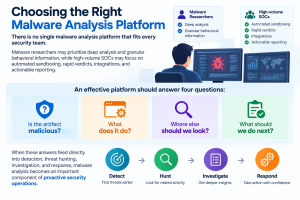
There is no single malware analysis platform that fits every security team.
Malware researchers may prioritize deep analysis and granular behavioral information, while high-volume SOCs may focus on automated sandboxing, rapid verdicts, integrations, and actionable reporting.
Ultimately, an effective platform should answer four questions:
Is the artifact malicious? What does it do? Where else should we look? What should we do next?
When these answers feed directly into detection, threat hunting, investigation, and response, malware analysis becomes an important component of proactive security operations.
Conclusion
As malware becomes more evasive, security teams need deeper visibility into suspicious files and behaviors.
Effective malware analysis platforms combine isolated execution, static and dynamic analysis, behavioral monitoring, threat intelligence, automation, and integrations. The objective is not simply to identify malicious files but to understand what they do and enable security teams to respond effectively.
Seqrite Malware Analysis Platform (SMAP) helps security teams analyze suspicious files in a secure, isolated environment and gain deeper visibility into potentially malicious behavior. It helps analysts uncover threat indicators, understand suspicious activity, and generate actionable intelligence that supports faster investigation and response.
For organizations looking to strengthen malware investigation capabilities, Seqrite SMAP can help teams move from identifying suspicious files to understanding and acting on the threats behind them.
Want deeper visibility into suspicious files and emerging malware? Explore Seqrite Malware Analysis Platform (SMAP) and strengthen your malware investigation capabilities.
Frequently Asked Questions
1. What is a malware analysis platform?
A malware analysis platform examines suspicious files, scripts, URLs, and other artifacts using techniques such as static analysis, dynamic analysis, sandboxing, and behavioral monitoring to determine how they behave and whether they pose a security risk.
2. Why do security teams need malware analysis platforms?
They help security teams investigate suspicious artifacts, understand malware behavior, identify IOCs, support threat hunting, and provide additional context for incident investigation and response.
3. What is the difference between static and dynamic malware analysis?
Static analysis examines a file without executing it, including its metadata, hashes, strings, and structure. Dynamic analysis executes it in an isolated environment to observe processes, file modifications, network communication, and persistence mechanisms.
4. What is sandboxing in malware analysis?
Sandboxing executes suspicious files or code inside an isolated environment where their behavior can be monitored without intentionally running them on production systems.
5. Can malware analysis platforms detect unknown malware?
They can help identify unknown or modified threats by analyzing characteristics and behavior rather than relying exclusively on known signatures. Effectiveness varies based on the malware, platform, execution environment, and evasion techniques.
6. What features should security teams look for?
Important capabilities include static and dynamic analysis, sandboxing, behavioral analysis, IOC extraction, network monitoring, multiple file-type support, anti-evasion capabilities, threat intelligence, automated reporting, APIs, and security-tool integrations.
7. How does malware analysis support threat hunting?
It identifies hashes, domains, IP addresses, processes, URLs, and behavioral patterns that threat hunters can search for across endpoints, networks, logs, SIEM, and XDR environments.
8. What is Seqrite Malware Analysis Platform (SMAP)?
Seqrite SMAP helps security teams investigate suspicious files in a controlled environment, understand potentially malicious behavior, uncover threat indicators, and generate intelligence that supports security investigations and response.