

Contents
- Introduction
- Key Targets
- Industries Affected
- Geographical focus
- Infection Chain
- Campaign Timeline
- Initial Findings
- Looking into the Decoy Document
- Technical Analysis
- Stage 1 -Initial infection through LNK
- Stage 2 – HIODropper
- Stage 3 – StageLoader
- Stage 4 – Native Loader and Its Encrypted Configuration
- Stage 5 – Azalea RAT 1.21.3
- Infrastructure & Attribution
- Conclusion
- Seqrite Protection
- Indicators of Compromise (IOCs)
- MITRE ATT&CK Mapping
Introduction
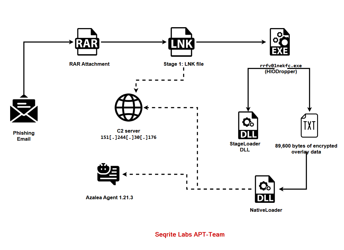
Seqrite Labs APT-Team recently analysed a spear-phishing campaign targeting Ukrainian government bodies, observed on 13 October 2026. The campaign used a seemingly legitimate email lure related to financial assistance for a Ukrainian military unit. The email contained a RAR archive named after an official letter from the Sumy Regional Military Administration regarding the redistribution of a subvention for military unit A1836. Inside the archive was a malicious LNK file that triggered a multi-stage infection chain.
Our analysis found that the infection chain eventually deploys Azalea Agent 1.21.3, a .NET-based remote access trojan. In this blog, we take a closer look at the infection chain, the agent’s encrypted resource containers, and how it uses RuntimeBroker.exe to host its plugins. Our investigation also uncovered interesting capabilities in this variant of the agent, along with insights into the campaign’s infrastructure and attribution.
Key Targets
Industries Affected
- Military/Government
Geographical focus
- Ukraine
Infection Chain
Initial Findings
In October 2026, we identified a phishing email targeting Ukrainian government officials. On 13 October 2026, the email was sent from an account on the government domain sm.gov.ua to recipients on the Donetsk regional government domain dn.gov.ua. It was presented as a forwarded message related to the Ukrainian armed forces.
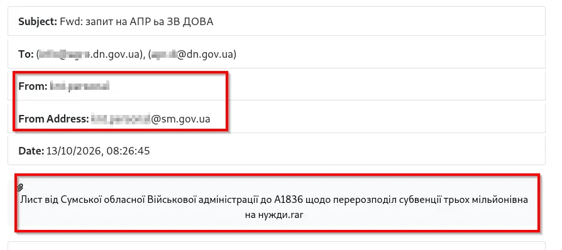
The email contained a RAR archive named Лист від Сумської обласної Військової адміністрації до А1836 щодо перерозподіл субвенції трьох мільйонівна на нужди.rar, which translates to “Letter from the Sumy Regional Military Administration to A1836 regarding the redistribution of a three-million subvention for needs”. In the following section, we examine the archive and trace how the attachment initiates the infection chain, ultimately leading to the deployment of a remote-access trojan on the victim’s system.
Technical Analysis
We have divided the technical analysis into five stages. The infection begins with a malicious LNK file that uses the built-in curl utility to download the second-stage executable from the C2 server. This executable contains an encrypted overlay, which it processes to extract a DLL. The DLL then decrypts the remaining data to produce the fourth-stage payload, a native loader that we identified as NativeLoader. NativeLoader reads its encrypted configuration, downloads the final payload, and loads it directly into memory using the .NET runtime. The final payload is Azalea Agent, the main malware analysed in this campaign.
Stage 1 – LNK-Based Initial Access
As observed in our initial findings, the RAR file contains a single attachment: an LNK file disguised as a PDF document. Let’s take a closer look at how this file works.

The shortcut is named Лист від Сумської обласної Військової адміністрації до А1836 щодо перерозподіл субвенції трьох мільйонівна на нужди.pdf.lnk, which translates to “Letter from the Sumy Regional Military Administration to A1836 regarding the redistribution of a three-million [hryvnia] subvention for needs”.
The LNK file points to cmd.exe and contains a one-line command that uses the built-in curl utility to download a file from http://151[.]244[.]30[.]176/194ff485-5d31-4a51-912e-b138e98ff750. The downloaded file is saved as rrfv01nekfc.exe in the user’s temporary directory and then executed in the background. This executable serves as the second stage of the campaign.
Stage 2 – HIODropper
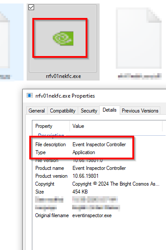
The LNK file downloads an executable named rrfv01nekfc.exe, which is the second stage of the campaign. Its metadata identifies it as “Event Inspector Controller” from “The Bright Cosmos Associates”. The original filename is listed as eventinspector.exe, the internal name as eventinspectorsvc, and the version as 10.66.19801. Interestingly, the executable uses an NVIDIA logo as its icon.
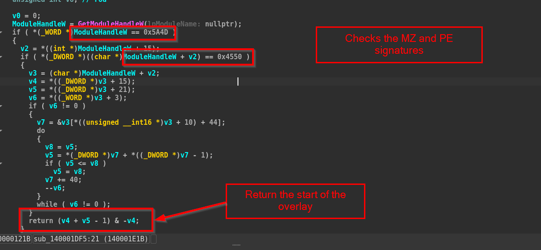
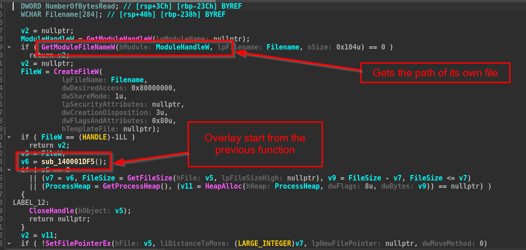
The executable contains a large block of extra data, into the overlay section, appended to the end of the PE file. The overlay is 425,632 bytes (around 416 KB). To locate it, the binary retrieves its own file path and calculates where the last section ends, taking file alignment into account. As shown in the image, it uses the formula (v4 + v5 – 1) & -v4 to calculate the starting offset of the overlay. This offset is then passed to another function, which reads and processes the overlay data.
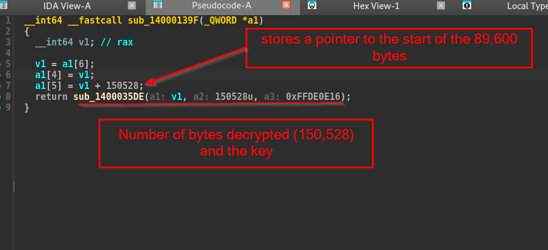
The executable then removes the filler bytes from the overlay, leaving 240,128 bytes of data. It decrypts the first 150,528 bytes using a custom routine with the key 0xFFDE0E16. The decrypted data produces a 64-bit DLL, which serves as the third stage of the infection chain.
The remaining 89,600 bytes are not decrypted by the executable itself. Instead, it passes a pointer to this data, along with its size, to the DLL’s exported function RunStage2 at offset RVA 0x1010. From this point, the DLL takes over and handles further processing.
In the next section, we will analyze the extracted DLL to understand its functionality and take a closer look at the RunStage2 exported function, which receives the remaining data from the overlay and handles the next stage of the infection chain.
Stage 3 – StageLoader
The second stage, extracted from the previous dropper, which we saved as stage3_dll.bin for analysis. The DLL is a 64-bit file. Its export table lists a single function, RunStage2. The second stage calls this function and passes it the remaining 89,600 bytes of encrypted data from the overlay, along with the size of the data.

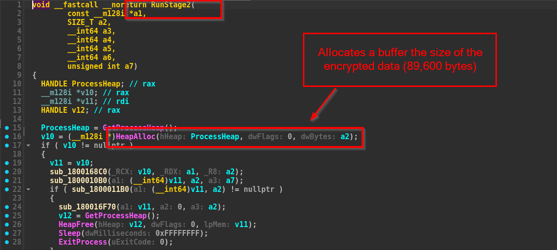
Decrypting the payload
RunStage2 first allocates a heap buffer of exactly 89,600 bytes and copies the encrypted data into it. It then decrypts the buffer in place, using the same kind of cipher that Stage 2 used for the DLL. To see how this works at run time, we used a debugger and watched the buffer change.
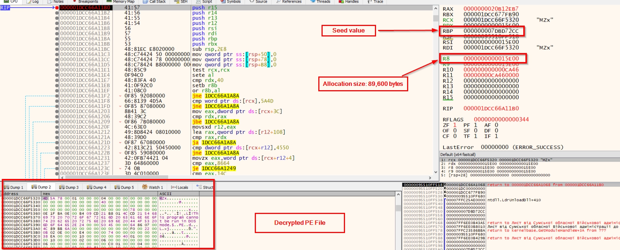
The main purpose of this decryption is to recover the executable hidden inside the encrypted 89,600-byte data block. RunStage2 copies the block into a heap buffer and decrypts it in place, using a custom cipher. The cipher does not change the size of the data, so the decrypted result is also 89,600 bytes. As mentioned in the image, when RunStage2 starts, it requests a heap buffer of exactly 0x15E00 bytes, and the seed 0x7DBD72CC is already in the RBP register. At the start of the decryption routine, the registers show the buffer address in RCX, the size 0x15E00 in RDX and the same seed in R8.
Once decryption is complete, the buffer starts with the MZ signature, followed by the standard DOS message, which confirms this data as PE file. RunStage2 does not write this file to disk, instead it hands the decrypted buffer to its own PE loader, which maps the executable straight into memory using NtCreateSection and NtMapViewOfSection. In the next section, we analyse the executable that RunStage2 loads into memory. It stores its configuration in a section named .didat, and we look at how that configuration is hidden, what it contains and how the program uses it to download the next payload.
Stage 4 – NativeLoader and Its Encrypted Configuration
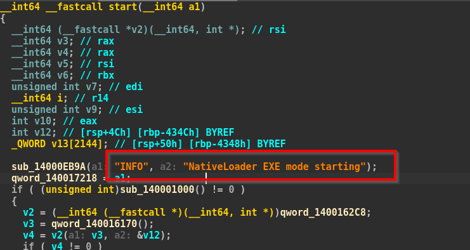
The executable that Stage 3 loads into memory is a 64-bit program, which we saved as stage4_loader.bin for analysis. When we opened it in IDA, the program’s own log messages show that it calls itself “NativeLoader”. The program resolves its required APIs at runtime by loading libraries such as winhttp.dll and advapi32.dll and retrieving the functions it needs.
Configuration discovery and decoding
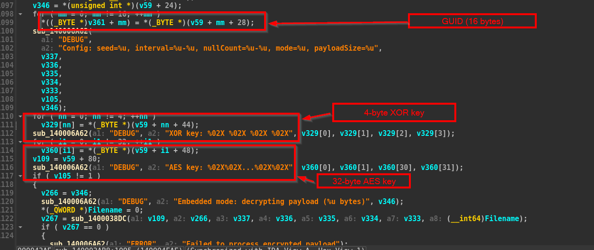
The loader looks for its configuration in an additional section named .didat. It identifies the section by its name and checks for a fixed marker beginning with DIDATSIG. The configuration is obfuscated using two layers. First, the loader removes the junk bytes using a seed and size ranges stored in the configuration. It then applies a repeating 4-byte XOR key to recover the actual data.
The decoded configuration contains several settings, including a mode byte, flags, expected payload size, GUID, a 4-byte XOR key, a 32-byte AES key, and a URL.
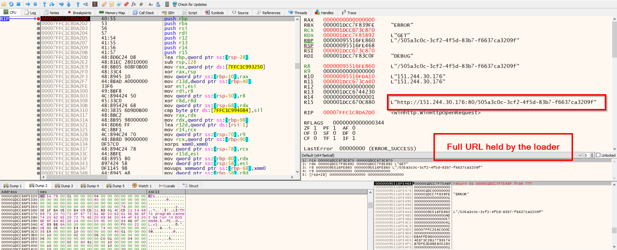
We analysed the sample in an isolated VM and used x64dbg to monitor its WinHTTP activity. After the stage4_loader.bin was mapped into memory, we observed a call to WinHttpCrackUrl with the URL http://151.244.30.176:80/505a3c0c-3cf2-4f5d-83b7-f6637ca3209f. The process then called WinHttpOpen with the user agent Mozilla/5.0 and access type 1 (no proxy), followed by WinHttpConnect to 151.244.30.176 on port 80. The loader then called WinHttpOpenRequest with the verb GET and the object name /505a3c0c-3cf2-4f5d-83b7-f6637ca3209f.
Decoding the downloaded payload
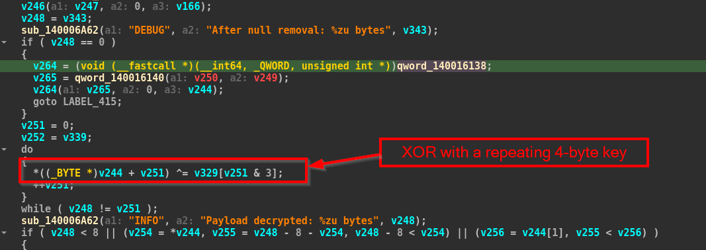
After downloading the payload, the loader decodes it in memory using two steps. First, it removes the junk bytes using the seed and size ranges stored in the configuration. It then applies the repeating 4-byte XOR key to recover the original data.
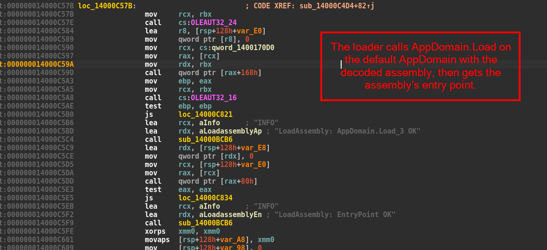
After decoding, the loader checks the layout of the result. The first four bytes hold the size of the .NET assembly and the next four hold the size of a second block, the IL map. The loader then starts the .NET runtime using CLRCreateInstance . Once the runtime is ready, it gets the default AppDomain and loads the decoded .NET assembly directly from a byte array using AppDomain.Load. It then retrieves the assembly’s entry point and executes it.
Stage 4 therefore acts as a downloader and in-memory loader for the final stage. In the next section, we look at the .NET assembly it runs, the Azalea agent.
Stage 5 – Azalea RAT 1.21.3
The data decoded and loaded by Stage 4 using AppDomain.Load is a .NET assembly. We opened it in dnSpy and examined its namespaces and classes. During the analysis, we found several obfuscated names and randomly generated strings.
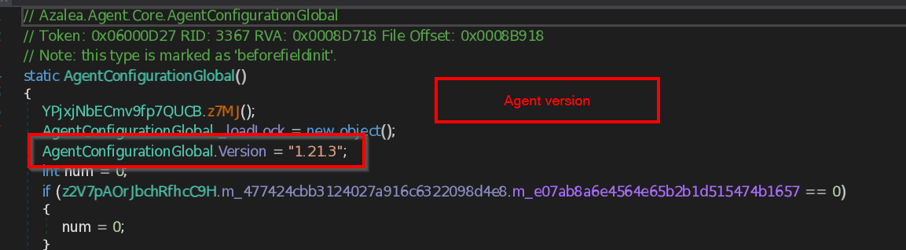
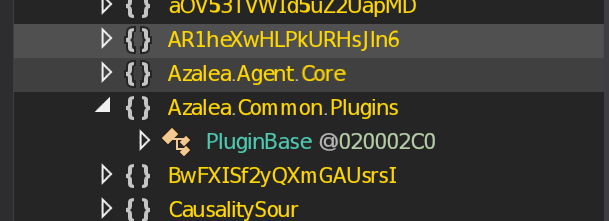
Upon carefully looking into the classes and other artefatcs, we confirmed that it is basically Azalea RAT, which is a .NET remote-access tooling, part of the Maas(Malware-As-A-Service) ecosystem, which has been discovered by researchers from various other threat research labs, as we saw that this exact variant, which is the most updated variant also follows the exact similar configurations as well as features such as anti-sandbox and feature rich capabilities as mentioned by researchers at ZeroLabs. Although the only difference lies around the infrastructure that the Azalea agent or the RAT connects to 151.244.30.176 on port 443 over TLS. It beacons to the path /api/health. This comes from the decrypted configuration and string table in the assembly, which we recovered post decryption. As, the agent has already been talked about much, we will get in depth into the technical details as it has already been talked about, but what’s important is to understand that nation-state actors have also started to add Azalea RAT or agent to target the victims across other nations. Next, we will focus on the infrastructural details in the upcoming sections.
Infrastructure & Attribution
The C2 server at 151[.]244[.]30[.]176 is hosted under AS399486, registered to “12651980 CANADA INC.”, a numbered Canadian corporation with no public-facing brand or identifiable owner.
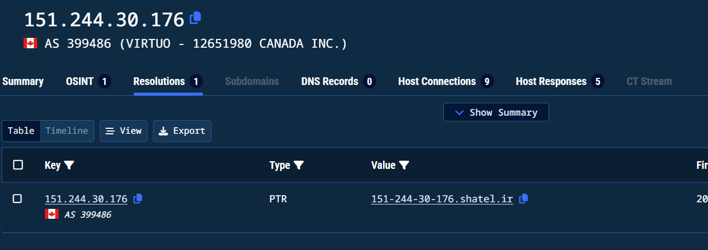
We pulled the passive DNS history for this IP from Validin and found a PTR record resolving to 151-244-30-176.shatel[.]ir. Shatel is one of Iran’s largest ISPs and this PTR format follows their standard rDNS naming convention. The record dates back to mid-2022 and remained associated with Shatel’s network until early 2025. This means the 151.244.30.0/24 block was part of Shatel’s network for around two and a half years before moving to its current Canadian ASN.
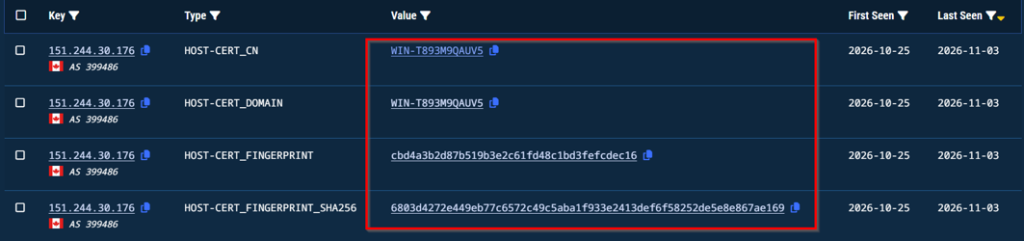
We also found a self-signed TLS certificate on port 3389 with the Common Name (CN) WIN-T893M9QAUV5. The hostname appears to be a default Windows machine name that was left in the certificate. It was issued on 23 October 2026, shortly after the campaign began. A global FOFA search for this CN returned only one result, pointing to the same IP address.
Cert SHA-256: 6803d4272e449eb77c6572c49c5aba1f933e2413def6f58252de5e8e867ae169
JA4X: 7022c563de38_7022c563de38_e73b053161df
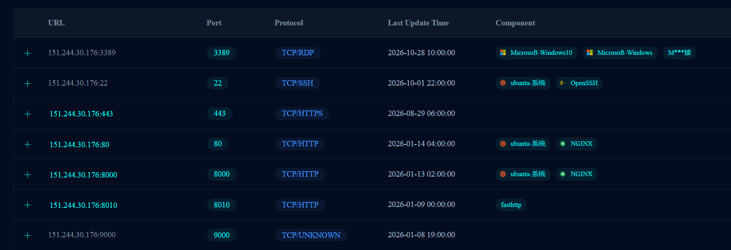
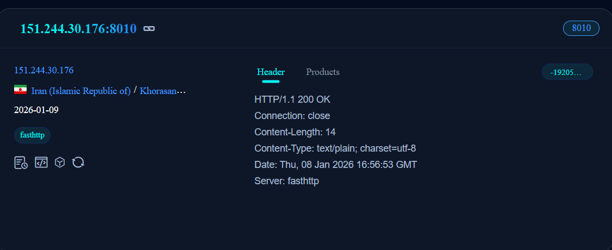
A FOFA scan revealed several services running on the server, including OpenSSH, NGINX, RDP, and Prometheus Node Exporter. We also identified a Go-based HTTP service (fasthttp) on port 8010, which we suspect is associated with the Azalea Agent C2 communication. In addition, around 30 HTTP listeners were found across ports 20012–20233, along with an authenticated SOCKS5 proxy on port 20201. This port arrangement resembles an FRP-based setup, potentially used for tunnelling and traffic forwarding.
At this time, we have not linked the campaign to any previously identified threat actor. Azalea Agent is a commercial Malware-as-a-Service (MaaS) tool available to multiple operators, and we found no confirmed infrastructure overlap with previously reported clusters. We therefore track this activity as an unattributed campaign.
Conclusion
We have uncovered a spear-phishing campaign targeting Ukrainian government bodies, observed in October 2026. Our analysis shows that the campaign uses a multi-stage infection chain to deliver Azalea Agent 1.21.3, with several layers of loading and encryption used to hide the final payload. We also found some interesting details about the C2 infrastructure, including its historical association with Shatel and a set of exposed services that may indicate the use of FRP for tunnelling. However, we found no confirmed links to infrastructure used by previously reported threat groups. We therefore track this activity as an unattributed campaign.
SEQRITE Protection
Lnk.Trojan.Downloader.51504.GC
Trojan.Sabsik
Indicators of Compromise (IOCs)
| File Name | File Hash (SHA-256) |
| rrfv01nekfc.exe | 240196bff6c00f5365df69ed50b7164f56e9b1831236b80edc0782ea1e167234 |
| stage3_dll.bin | 46f8061e237bcc615a0b17b83ff4042853ec42327034e1e3dba6df5f873264bb |
| stage4_loader.bin | 5f4bc01dea3f65f2612a7e1ecb369e244e2417b2af8b0df7425b9ff04ff75101 |
| Azalea Agent 1.21.3 | 564754458cf28616e072c9b5fcb01ebe1de452a652c9b74fd1548c95ae257f5b |
C2 URLs
| 151[.]244[.]30[.]176 |
| hxxp://151[.]244[.]30[.]176/194ff485-5d31-4a51-912e-b138e98ff750 |
| hxxp://151[.]244[.]30[.]176:80/505a3c0c-3cf2-4f5d-83b7-f6637ca3209f |
MITRE ATT&CK Mapping
| Tactic | Technique ID | Technique Name |
| Initial Access | T1566.001 | Phishing: Spearphishing Attachment |
| Execution | T1204.002 | User Execution: Malicious File |
| T1059.003 | Command and Scripting Interpreter | |
| T1106 | Native API | |
| Persistence | T1053.005 | Scheduled Task/Job |
| T1547.001 | Boot or Logon Autostart Execution: Registry Run Keys / Startup Folder | |
| Defense Evasion | T1036 | Masquerading |
| T1027 | Obfuscated Files or Information | |
| T1027.007 | Obfuscated Files or Information: Dynamic API Resolution | |
| T1027.009 | Obfuscated Files or Information: Embedded Payloads | |
| T1140 | Deobfuscate/Decode Files or Information | |
| T1564.003 | Hide Artifacts: Hidden Window | |
| Discovery | T1082 | System Information Discovery |
| T1057 | Process Discovery | |
| T1083 | File and Directory Discovery | |
| T1056.001 | Input Capture: Keylogging | |
| T1115 | Clipboard Data | |
| T1113 | Screen Capture | |
| Command and Control | T1071.001 | Application Layer Protocol: Web Protocols |
| T1573 | Encrypted Channel |
Authors:
Priya Patel
Kartik Jivani