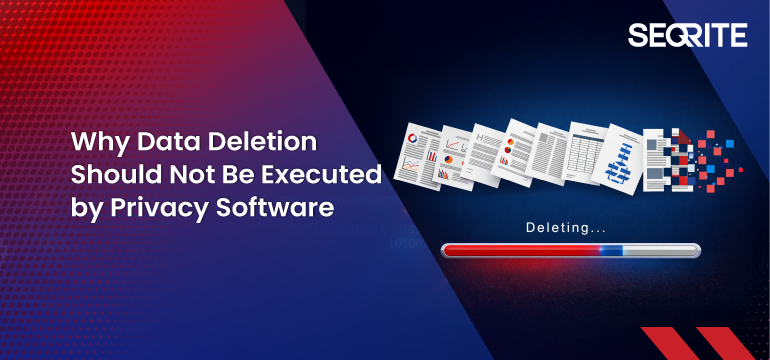

We are excited about Seqrite Data Privacy moving from lab to dogfooding to customer usage. Sometimes, we encounter a Data Deletion requirement in Seqrite Data Privacy, a privacy Management software.
In the rapidly evolving landscape of global data regulation, from the European GDPR to India’s Digital Personal Data Protection (DPDP) Act, the pressure to “minimize” data has never been higher. DPOs and other compliance officers are increasingly enticed by the promise of “automated data deletion” offered by privacy platforms. However, granting a software script the autonomous power to purge records is a high-stakes gamble. We argue that while privacy software is invaluable for discovery and orchestration, the act of deletion must remain a human-led, system-native process.
Legal Holds vs. Retention Rules
The primary failure of automated deletion is its inability to “read the room.” Compliance software operates on fixed logic (e.g., “Delete 7 years after account closure as per RBI”). However, legal reality is fluid.
- The Risk of Spoliation: If a company is served with a subpoena or tax audit, a Legal Hold must immediately override standard retention.
- The Consequence: An automated script may inadvertently purge evidence, leading to “adverse inference” rulings where a judge assumes the deleted data contained proof of wrongdoing. No algorithm can currently synthesize the shifting legal landscape of a global firm well enough to pause in the face of a dispute.
Governance vs. Execution
Privacy tools are fundamentally Governance, Risk, and Compliance (GRC) systems, not systems of record. We have seen this with popular GRC tools such as Archer or MetricStream.
- Referential Integrity: Modern enterprise systems are a web of relational databases. When an external privacy tool forces a deletion in a CRM, it often leaves “orphaned” records in finance or supply chain modules.
- System Ownership: Only the system that “owns” the data (ERP, Core Banking, etc.) understands its dependence. Deletion should be a requested action that the source system executes according to its own internal business logic, ensuring system stability.
A New Attack Vector
Centralizing destructive power within a single compliance tool creates a Single Point of Failure. With our 30 years of experience in Security, allowing a central solution to handle deletions can be treacherous.
- The Scorched-Earth Event: If a threat actor or disgruntled employee gains access to the privacy platform, they possess a “Global Kill Switch.” Instead of exfiltrating data, they can trigger a global purge under the guise of a “compliance cleanup.”
- Security Paradox: By trying to solve a privacy risk, organizations inadvertently create a catastrophic cyber-resilience risk by over-privileging a single third-party tool.
Privacy vs. Sectoral Mandates
In a globalized economy, data is subject to contradictory mandates.
- The Indian Context: While the DPDP Act demands minimization, the Income Tax Act and SEBI regulations require retention for eight years or more.
- Adjudication: Deletion requires a cross-functional human decision involving legal, tax, and IT. Automated tools struggle to adjudicate these “conflicts of laws,” potentially satisfying a privacy officer while simultaneously triggering a financial regulatory violation.
Fallacy of AI and “False Positives”
Many tools claim to use AI to identify and delete Personally Identifiable Information (PII). We use a combination of RegEx and AI to double-check the identification of personal and PII data.
- Irreversibility: AI is prone to false positives—misidentifying proprietary code or critical serial numbers as PII.
- Operational Hazard: Unlike “Move” or “Archive” commands, “Delete” is binary. Once bits are overwritten, the intellectual property or historical record is gone forever. The risk of AI-driven “over-deletion” is a hazard few CTOs can justify.
Data Fiduciary’s Burden
Under the DPDP Act, the legal responsibility lies with the Data Fiduciary (the company), not the software vendor.
- Liability: If an automated tool deletes the wrong data—or fails to delete it correctly, the company faces penalties up to ₹250 crore.
- Human-in-the-Loop: Delegating legal liability to a third-party script is a dereliction of governance. A “Human-in-the-Loop” model ensures that the Data Protection Officer (DPO) provides an audit trail of human accountability that software cannot replicate.
Moving Toward “Orchestrated Governance”
The goal of a Privacy Compliance system should be to orchestrate deletion, not to execute it. The most mature organizations treat privacy software as an “Advisor” that:
- Identifies data reaching end-of-life.
- Flags records for departmental review.
- Verifies the absence of legal holds.
- Triggers a request for the source system to perform a native, safe deletion.
By keeping a human at the center of the “Delete” command, organizations protect themselves from technical debt, legal spoliation, and security catastrophes. In the age of AI, the most sophisticated tool isn’t the one that deletes the most data; it’s the one that provides the clearest information for a human to make the final, irreversible choice.