Seqrite Data Privacy
Empower Your Business to Discover, Classify, and Protect Sensitive Data While Fulfilling Data Principal Rights Requests. Empower your organization to comply with privacy regulations like DPDPA, GDPR, PCI-DSS, etc. by automating sensitive data discovery, classification, and labelling, while seamlessly managing Data Principal request rights. Provide users with clear and simple options to manage their consent and preferences across multiple touchpoints & ensure compliance with global and local privacy laws. Automate privacy assessments, including DPIA, gap analysis, and RoPA, to identify risks and ensure that your organization’s data privacy practices are continuously up to date and compliant. Automate and manage the handling of Data Principal rights to provide quick and efficient responses to requests while maintaining compliance with privacy regulations. AI-enabled contextual PII analysis, image PII recognition, Seqrite Data Privacy helps organizations discover, classify, and label sensitive customer data across enterprise data resources, ensuring compliance with privacy laws such as DPDPA, CCPA, and GDPR. It reduces operational complexity, mitigates data risks, and enhances transparency, allowing organizations to effectively protect sensitive data and maintain customer trust. Efficiently discover and classify sensitive data such as Personal Data (PD) and Personally Identifiable Information (PII) across 500+ data sources. Leverage 150+ prebuilt classifiers or create custom classifiers to ensure proper data handling and regulatory compliance. Automatically apply visual labels and watermarks to headers/footers of the documents to clearly indicate sensitivity levels, enhancing correct handling, access control, and auditability. Gain visibility into a complete profile of any data principal by locating their Personal Data (PD) or Personally Identifiable Information (PII) across various organizational data sources. This creates a unified view of the data principal and supports data governance and privacy compliance efforts. Manage consent and preferences from a centralized dashboard to gain real-time control across platforms. Provide your customers with an intuitive portal that lets them update or revoke preferences easily, and build trust through transparent consent handling. With Bhashini-powered multilingual support, consent notices and preference options appear in 22 Indian languages, meeting DPDPA requirements and improving user clarity. Automatically discover cookies across your websites and implement customizable consent banners. Empower visitors to opt-in or opt-out of cookie tracking and maintain compliance with global & local privacy laws. Automate the process of conducting privacy risk assessments like DPIA, RoPA, and gap assessments. Leverage 10+ Prebuilt Assessment templates or create a custom assessment template as per organizational requirements. Simplify the identification of data privacy risks and ensure continuous compliance with data protection regulations. Streamline and automate the management of Data Principal rights requests through a case management workflow and ensure timely and compliant responses to data access, rectification, and deletion requests as per regulations requirement. Efficiently log and track data breach incidents—schedule and trigger notifications to the right stakeholders, ensuring timely compliance with DPDP requirements. Create tailored templates for the target audience and reuse them in relevant communications. Pre-built integrations with leading DLP solutions enable seamless data flow from the DP platform into DLP systems for centralized policy enforcement and data protection. Integrations with popular ITSM platforms trigger automated workflows for incident triage, escalation, and remediation, enabling streamlined operations. Efficiently handle Data Principal rights requests by efficiently searching, detecting, and locating data across applications and databases. Maintain comprehensive visibility into your data privacy posture through detailed scans of multiple data sources, ensuring alignment with data protection policies. Comply with global and local data privacy regulations such as DPDPA, GDPR, HIPAA, PDPA, and CCPA, and avoid hefty penalties due to non-compliance. View consolidated data records on a single dashboard, with granular filtering options for deep insights into data compliance and privacy posture. Implement robust role-based access controls to manage user permissions and enforce least privilege access principles, safeguarding sensitive data from unauthorized access. Seamlessly integrate with other Seqrite products via Seqrite Centralized Security Management, enhancing overall security monitoring and extending data privacy practices across all corporate endpoints. Secure Your Business with Effortless Data Privacy ManagementBalance Contextual Data Privacy with Holistic Cyber Security
Ensure Data Privacy Compliance
Enhance User Transparency and Control
Streamline Privacy Assessments
Manage Data Principal Rights Efficiently
GoDeep.AI Privacy Intelligence
and multilingual consent enablement.
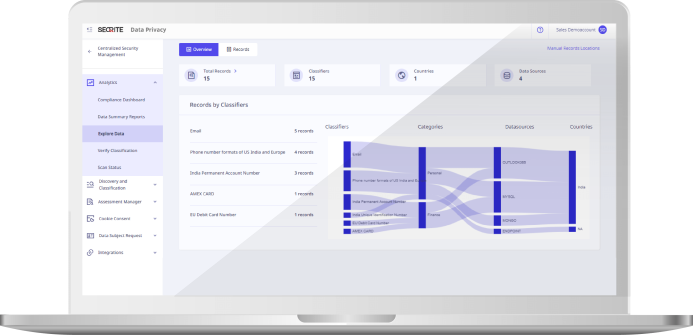
Seqrite Data Privacy:
Effortless Privacy Management across Locations
Core Capabilities of Seqrite Data Privacy
Data Discovery & Classification
Visual Markers
Unified Data Profiling
Universal Consent & Preference Management
Cookie Consent Management
Privacy Risk Assessment Automation
Data Principal Rights Request Management
Data Breach Notifications
Native Platform Integrations
Take Control of Your Data and Build
Customer Trust with Seqrite Data PrivacyStreamlined Management
Enhanced Data Cognition
Intuitive Data Compliance
Superior Insights
Effective Data Security
Powerful Integrations
Resources

Deep Dive into DPDP Rules for Implementation and Compliance
India took a groundbreaking step towards strengthening data protection with the release of the draft Digital Personal Data Protection Rules,…
Read more
The What, How, and Why of Data Privacy
Data privacy is a cornerstone of modern business operations and consumer trust in an increasingly digital world. Every click, transaction,…
Read more
The Beginners Guide To Digital Personal Data Protection Law
In the digital age, the protection of personal data is of paramount importance. The Digital Personal Data Protection (DPDP) Act…
Read moreFrequently Asked Questions
Seqrite Data Privacy empowers these roles by providing automated data discovery & classification, unified data visibility, automated privacy risk assessments (DPIA, RoPA), case workflows to manage individual rights requests, and comprehensive dashboards/reports – helping teams fulfil regulatory compliance obligations, reduce manual effort, and improve audit readiness.
Yes – Seqrite’s licensing is modular. You can begin with essential modules such as Data Discovery & Classification and scale up as your privacy program matures or regulatory requirements expand. This approach helps control costs while enabling phased adoption.
Seqrite Data Privacy supports flexible deployment models including cloud, on-premise, and hybrid configurations while allowing organizations to choose the model that fits their data governance, security, and compliance needs.
Seqrite Data Privacy includes ready-to-use connectors for 500+ data sources, ranging from databases and SaaS apps to cloud storage, file servers, collaboration tools, and endpoints across Windows, Linux, and macOS. And if you need a connector that isn’t available out-of-the-box, our low-code framework allows us to quickly develop and add new ones to support your environment.
Seqrite Data Privacy offers case-based workflows for rights management – letting you search, locate, and act upon personal data based on requests like access, rectification, deletion, etc., with audit logs and status tracking to ensure timely and compliant responses.
Seqrite Data Privacy includes a library of predefined assessment templates that can be used out-of-the-box. These templates are delivered as structured questionnaires and cover DPIA, RoPA, privacy gap assessments, third-party risk assessments (internal and external), NIST Privacy Framework checklists, GDPR compliance checklists, and PIA pre-screening. Teams can conduct assessments efficiently while ensuring consistency and comprehensive coverage.
Yes. Seqrite Data Privacy offers a centralized consent and preference management module that helps organizations collect, track, and update customer consent across digital channels. It enables you to honor consent changes in real time, manage purpose and communication preferences, and maintain a clear audit trail – making it easier to demonstrate compliance and build trust with customers.
It includes breach notification feature that log incidents, trigger alerts, and allow customizable notification templates to ensure relevant stakeholders are informed quickly and consistently during data privacy incidents.
Yes. While Seqrite Data Privacy is designed with India’s DPDP Act in mind, the platform is flexible and configurable, making it adaptable for global privacy requirements. Its policy frameworks, assessment templates, consent models, and workflows can be tailored to align with regulations such as GDPR, CCPA, HIPAA, and others – allowing organizations to scale their privacy programs across regions.
DLP focuses on preventing data loss or leakage, typically by monitoring and controlling data movement. Seqrite Data Privacy complements DLP by discovering where personal data resides, classifying it, managing consent, enabling privacy assessments, and supporting regulatory compliance. In short—DLP protects data in motion, while Data Privacy gives visibility, governance, and compliance for data at rest and in use.
Yes. Seqrite Data Privacy can integrate with existing DLP tools through multiple approaches. The platform supports data discovery and classification outputs that can be shared with DLP policies, and it can exchange alerts and insights to help strengthen data protection workflows. This allows organizations to continue using their existing DLP investments while enhancing visibility and compliance with Seqrite Data Privacy.
Contact our Cybersecurity Experts