
The Attack You Never Saw Coming
It started with an email that looked completely legitimate.
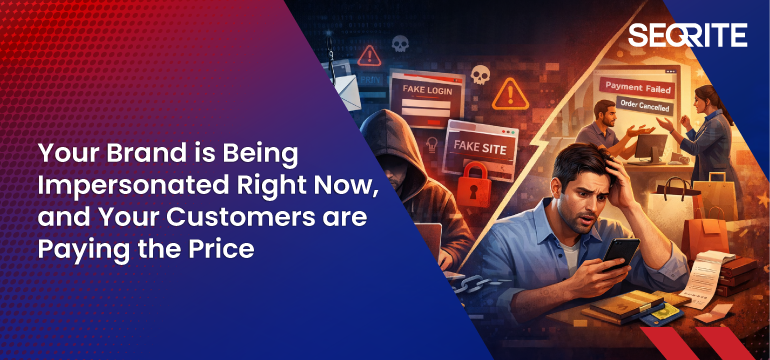
A customer of a mid-size private bank in Pune received a message asking her to verify her net banking credentials following a “routine security update.” The sender’s domain was firstindiabnk.in, close enough to the real thing that she didn’t hesitate. The design, tone, and branding matched every communication she had ever received from her bank.
She clicked. She entered her username, password, and OTP.
Within four hours, ₹1.8 lakh was gone.
The domain had been registered just three weeks earlier by an attacker operating in India. For twenty-one days, it quietly harvested credentials before the first complaint surfaced. By then, seventeen customers had already been defrauded.
The bank had no visibility into the attack. No alerts. No warnings.
Because the attack never touched their infrastructure.
India’s Brand Impersonation Epidemic
This is no longer an isolated incident. It is a rapidly growing pattern.
India has witnessed a surge of over 300% in brand impersonation attacks between 2024 and 2025, making it one of the fastest-growing cybercrime categories in the country.
What began as simple spoofed emails has evolved into a multi-channel threat ecosystem:
Lookalike domains that mirror legitimate websites
Fraudulent mobile apps using real brand assets
Fake executive profiles across LinkedIn, Instagram, and WhatsApp
Stolen employee credentials traded on dark web forums
These campaigns are increasingly sophisticated. Attackers now leverage AI-generated content, pixel-perfect website clones, and highly convincing social engineering tactics that are nearly indistinguishable from legitimate communication.
But the most important shift is who is being targeted.
Large enterprises have strengthened their defenses. Attackers have adapted accordingly.
Mid-market organizations, with strong brand recognition but limited security bandwidth, have become the primary targets.
Why Your Security Stack Can’t See This
Here’s the uncomfortable truth:
Most security tools were never designed to detect brand impersonation.
Firewalls monitor network traffic.
Endpoint and antivirus solutions protect devices.
EDR and XDR platforms detect threats inside your environment.
But brand impersonation doesn’t operate within your environment.
A malicious domain hosted overseas will never trigger your firewall.
A phishing site targeting your customers will never touch your endpoints.
A fake LinkedIn profile impersonating your CFO will never appear in your logs.
These attacks operate entirely outside your perimeter, directly targeting your customers, partners, and employees.
By the time you hear about them, they’ve already succeeded.
The Three Blind Spots Leaving You Exposed
-
Lookalike Domain Registration
Attackers rapidly register multiple variations of your domain using automated tools.
A single brand can have dozens of malicious lookalikes created within days, each capable of launching phishing campaigns. None of them appears in your internal security systems.
-
Dark Web Credential Exposure
Employee credentials are frequently harvested and sold on dark web marketplaces, often weeks before any breach is detected.
These credentials provide attackers with direct access to corporate systems, email accounts, and sensitive data.
-
Social Media Impersonation
Fake profiles impersonating executives and brands are now common across platforms.
These profiles are used for:
- Phishing and fraud
- Business email compromise (BEC)
- Misinformation campaigns
In many cases, attackers build credibility over time before executing fraud.
What Protection Actually Looks Like
Defending against brand impersonation requires a fundamental shift, from reactive response to proactive visibility.
This is where Seqrite Digital Risk Protection Services (DRPS) comes in.
Seqrite DRPS continuously monitors the external threat landscape, including:
- Open web and domain registrations
- Dark web forums and marketplaces
- Social media platforms
- Mobile app stores
The goal is simple: detect threats before they are weaponized.
When a lookalike domain is registered, you are alerted within hours.
When employee credentials appear on the dark web, you are notified immediately.
When a fake executive profile goes live, action can be taken before it gains traction.
But detection alone is not enough.
Seqrite DRPS also enables rapid takedown of malicious assets through established relationships with registrars, hosting providers, and digital platforms, often within 24 to 48 hours.
This dramatically reduces the window of exploitation.
The Cost of Doing Nothing
The impact of brand impersonation goes far beyond immediate financial loss.
Regulatory scrutiny is increasing. Authorities like the Reserve Bank of India (RBI) and SEBI are placing greater emphasis on fraud prevention and customer protection.
Failure to monitor and mitigate impersonation risks can lead to:
- Regulatory investigations
- Financial penalties
- Legal liability
- Mandatory remediation efforts
And then there is the cost that is hardest to quantify, loss of customer trust.
When customers are defrauded under your brand name, they don’t differentiate between external attackers and internal failure.
They simply leave.
Find Out What Attackers Already Know About You
The most dangerous aspect of brand impersonation is not that it happens.
It’s that it is likely to happen right now, without your knowledge.
Seqrite DRPS helps you uncover that reality.
Our threat research team offers a complimentary Brand Risk Assessment, a real-time scan of your brand’s exposure across domains, dark web, social media, and digital channels.
No cost. No commitment. Just actionable intelligence.
Because the first step to stopping an attack is knowing it already exists.