
• Products & Services
        • Cloud

          • Endpoint Protection
          • Endpoint Detection and Response
          • Mobile Device Management
          • BYOD
          • Extended Detection and Response
          • Zero Trust Network Access
          • Data Privacy
        • On Prem

          • Endpoint Protection
          • Endpoint Detection and Response
          • Data Privacy
        • Platform

          • Malware Analysis Platform
        • Small Business

          • SOHO Total Edition
        • Services

          • Threat Intel
          • Digital Risk Protection Services (DRPS)
          • Ransomware Recovery as a Services (RRaaS)
          • DPDP Compliance
          • Managed Detection and Response
  • Solutions
    • BFSI
    • Education
    • Government
    • Healthcare
    • ITeS
    • Manufacturing
  • Company
    • About Seqrite
    • Leadership
    • Awards & Certifications
    • Newsroom
  • Partners
    • Partner Program
    • Locate Partner
    • Become A Partner
  • Support
  • Resources
    • Blogs
    • Whitepapers
    • Datasheets
    • Case Studies
    • Threat Reports
    • Manuals
    • PoV
    • Understanding Data Privacy
    • DPDP Dialogues
Blogs on Information Technology, Network & Cybersecurity | Seqrite Blog
Contact Sales
  • Products & Services
        • Cloud

          • Endpoint Protection
          • Endpoint Detection and Response
          • Mobile Device Management
          • BYOD
          • Extended Detection and Response
          • Zero Trust Network Access
          • Data Privacy
        • On Prem

          • Endpoint Protection
          • Endpoint Detection and Response
          • Data Privacy
        • Platform

          • Malware Analysis Platform
        • Small Business

          • SOHO Total Edition
        • Services

          • Threat Intel
          • Digital Risk Protection Services (DRPS)
          • Ransomware Recovery as a Services (RRaaS)
          • DPDP Compliance
          • Managed Detection and Response
  • Solutions
    • BFSI
    • Education
    • Government
    • Healthcare
    • ITeS
    • Manufacturing
  • Company
    • About Seqrite
    • Leadership
    • Awards & Certifications
    • Newsroom
  • Partners
    • Partner Program
    • Locate Partner
    • Become A Partner
  • Support
  • Resources
    • Blogs
    • Whitepapers
    • Datasheets
    • Case Studies
    • Threat Reports
    • Manuals
    • PoV
    • Understanding Data Privacy
    • DPDP Dialogues
Home  /  Technical  /  Secure Communication Protocols and Their Implementation
13 March 2026

Secure Communication Protocols and Their Implementation

Written by Umar Khan A
Umar Khan A
Technical

From Encryption to Real-World Attack Prevention

In today’s hyper-connected digital environment, secure communication is not just about encrypting data—it is about preventing attackers from abusing exposed services. Secure communication protocols protect data in transit, but misconfigurations and weak access controls often turn legitimate protocols into attack vectors.

This blog explores secure communication protocols, their implementation, real-world threats such as brute-force attacks, and practical defensive measures aligned with industry best practices.

1. Introduction to Secure Communication Protocols

Secure communication protocols are standardized rules and mechanisms that protect data exchanged across networks. Their primary goals are:

  • Confidentiality – preventing unauthorized disclosure
  • Integrity – ensuring data is not altered in transit
  • Authentication – verifying the identity of communicating parties

Without these protocols, attackers can intercept, manipulate, or impersonate legitimate communications.

2. Core Secure Communication Protocols

TLS/SSL

TLS (formerly SSL) is the backbone of secure internet communication.

  • Use cases: HTTPS, APIs, email transport
  • Security model: Asymmetric key exchange + symmetric encryption
  • Implementation: Requires valid certificates issued by trusted Certificate Authorities (CAs)

IPsec

IPsec secures communication at the network layer.

  • Use cases: VPNs, site-to-site tunnels
  • Modes: Transport (payload only), Tunnel (entire packet)
  • Strength: Protects traffic regardless of application

SSH

SSH enables secure remote administration.

  • Use cases: Remote login, command execution, file transfer
  • Security: Public key authentication and encrypted sessions

S/MIME

S/MIME secures email communication using PKI.

  • Capabilities: Email encryption and digital signatures
  • Trust model: Certificate-based identity verification

HTTPS

HTTPS combines HTTP with TLS to secure web traffic.

  • Critical for: E-commerce, authentication portals, APIs
  • Risk if misconfigured: Weak ciphers or expired certificates.

3. Where Secure Protocols Fail in Practice

Even when secure protocols are deployed, attackers often bypass encryption by targeting authentication weaknesses, especially on services exposed to the internet.

Commonly abused services:

  • SMB (445)
  • RDP (3389)
  • MSSQL (1433)

The most frequent attack technique against these services is the brute-force attack, where automated tools attempt thousands of credential combinations until access is gained.

4. Brute-Force Attacks: Turning Secure Services into Entry Points

What Is a Brute-Force Attack?

A brute-force attack systematically attempts multiple username and password combinations to gain unauthorized access. Once successful, attackers may:

  • Deploy malware or ransomware
  • Steal sensitive data
  • Establish persistent access

These attacks are especially effective against publicly exposed services with weak authentication controls.

5. Attack Flow (Conceptual Diagram)
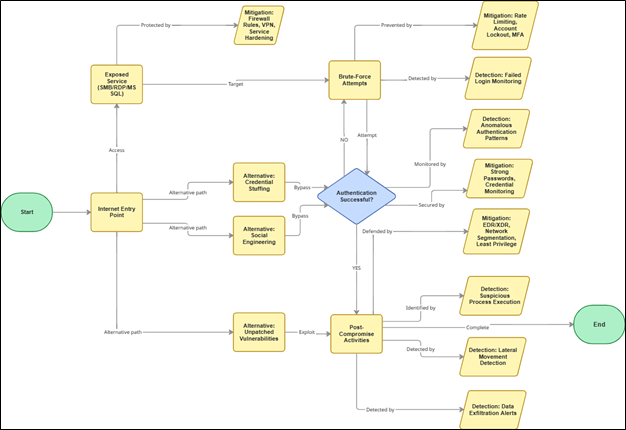
Brute-Force Attack Lifecycle and Defensive Controls

This flow highlights a critical reality: encryption alone does not stop credential abuse.

6. MITRE ATT&CK Mapping

Attack Stage MITRE Technique
Credential Guessing T1110 – Brute Force
Valid Account Abuse T1078 – Valid Accounts
Remote Access T1021 – Remote Services
Credential Access (Post-Compromise) T1003 – OS Credential Dumping
Persistence T1053 – Scheduled Tasks / Jobs

This mapping shows how a simple brute-force attempt can evolve into a full intrusion lifecycle.

7. Defensive Controls: Securing Services Beyond Encryption

Authentication Hardening

  • Use strong, unique, complex passwords
  • Avoid default usernames such as Administrator, Admin, SA, root
  • Enforce periodic password rotation policies

Account Lockout Policies

  • Lock accounts after a defined number of failed attempts
  • Apply time-based or administrator-unlock policies to slow automated attacks

MSSQL-Specific Protection

  • Disable default SA account
  • Change default port 1433
  • Restrict public access to database services
  • Apply least-privilege access controls

Network Exposure Reduction

  • Monitor and restrict access to common attack ports:
    • SMB – 445
    • RDP – 3389
    • MSSQL – 1433
  • Allow access only from trusted IP addresses

VPN Over Direct Exposure

Use VPNs with encrypted tunnels instead of direct NAT or port forwarding to reduce attack surface.

Multi-Factor Authentication (MFA)

Enable MFA on all internet-facing services to render brute-force attacks ineffective, even if credentials are compromised.

Defensive Checklist

Use this as a quick security baseline:

  • ☐ TLS/SSL certificates valid and using strong ciphers
  • ☐ SMB, RDP, MSSQL not publicly exposed
  • ☐ Strong password & lockout policies enforced
  • ☐ Default accounts disabled or renamed
  • ☐ MFA enabled on external services
  • ☐ VPN used instead of direct access
  • ☐ IDS/IPS logs reviewed regularly
  • ☐ Common ports strictly monitored
  • ☐ Incident response plan documented

8. Conclusion

Secure communication protocols are foundational to cybersecurity—but they are not sufficient on their own. Real-world security requires combining encryption with strong authentication, controlled exposure, continuous monitoring, and incident readiness.

By aligning secure protocol implementation with brute-force prevention strategies and MITRE ATT&CK–informed defenses, organizations can significantly reduce their attack surface and strengthen their overall security posture.

Authors:

Niraj Lazarus Makasare
Sumit Patil
Umar Khan A

 Previous PostAI in Cybersecurity: A Game Changer or Overhyped?
Next Post  Operation CamelClone: Multi-Region Espionage Campaign Targets Gov...
Umar Khan A

About Umar Khan A

Umar Khan A is a Principal Security Researcher at Quick Heal's Security Labs. Passionate security researcher specializing in digital forensics and malware analysis....

Articles by Umar Khan A »

Related Posts

  • Operation CamelClone: Multi-Region Espionage Campaign Targets Government and Defense Entities Amidst Regional Tensions

    Operation CamelClone: Multi-Region Espionage Campaign Targets Government and Defense Entities Amidst Regional Tensions

    March 13, 2026
  • Inside a Multi-Stage Android Malware Campaign Leveraging RTO-Themed Social Engineering

    February 4, 2026
  • Operation DupeHike : UNG0902 targets Russian employees with DUPERUNNER and AdaptixC2

    January 20, 2026
Featured Authors
  • Seqrite
    Seqrite

    Seqrite is a leading enterprise cybersecurity solutions provider. With a focus...

    Read more..
  • Jyoti Karlekar
    Jyoti Karlekar

    I'm an avid writer who enjoys crafting content about emerging technologies and...

    Read more..
  • Bineesh P
    Bineesh P

    I am a passionate cybersecurity enthusiast and a dedicated writer. With a knack...

    Read more..
  • Sanjay Katkar
    Sanjay Katkar

    Sanjay Katkar is the Joint Managing Director of Quick Heal Technologies...

    Read more..
Topics
apt (25) Cyber-attack (36) cyber-attacks (58) cyberattack (16) cyberattacks (15) Cybersecurity (335) cyber security (34) Cyber threat (33) cyber threats (50) data breach (56) data breaches (29) data loss (28) data loss prevention (34) data privacy (15) data protection (32) data security (17) DLP (50) DPDP (14) DPDPA (16) Encryption (16) endpoint security (110) Enterprise security (18) Exploit (13) GDPR (13) malware (76) malware analysis (13) malware attack (23) malware attacks (12) MDM (27) Microsoft (15) Network security (24) Patch Management (12) phishing (29) Ransomware (69) ransomware attack (30) ransomware attacks (30) ransomware protection (14) Seqrite (41) Seqrite Encryption (27) Seqrite EPS (33) Seqrite Services (16) Threat Intelligence (13) UTM (34) Vulnerability (16) zero trust (13)
Blogs on Information Technology, Network & Cybersecurity | Seqrite

Leading enterprise IT security solutions provider simplifying endpoint, data, and network security with best-in-class threat prevention, detection, and response solutions worldwide.

Read More

Follow us:

Subscribe To Our Newsletter

Stay informed about the latest cybersecurity trends and insights.

Loading
Products & Services
  • Cloud
  • Endpoint Protection
  • Endpoint Detection and Response
  • Mobile Device Management
  • BYOD
  • Extended Detection and Response
  • Zero Trust Network Access
  • Data Privacy
  • On Prem
  • Endpoint Protection
  • Endpoint Detection and Response
  • Data Privacy
  • Platform
  • Malware Analysis Platform
  • Micro Business
  • SOHO Total Edition
  • Services
  • Threat Intel
  • Digital Risk Protection Services (DRPS)
  • Ransomware Recovery as a Services (RRaaS)
  • DPDP Compliance
  • Managed Detection and Response
Resources
  • Blogs
  • Whitepapers
  • Datasheets
  • Threat Reports
  • Manuals
  • PoV
  • Understanding Data Privacy
  • DPDP Dialogues
  • Policy & Compliance
  • EULA
  • GoDeep.AI
  • SIA
Contact Us
  • Registered Offices
  • Nearest Offices
  • Let’s Talk Cybersecurity
Support
  • Technical Support
  • Download Software
  • Offline Updater
  • Firmware Upgrades
  • Upgrades
  • Product Documentation
About Us
  • About Seqrite
  • Leadership
  • Awards & Recognition
  • Newsroom
Partner
  • Partner Program
  • Locate Partner
  • Become A Partner
  • Seqrite Certification

© 2026 Quick Heal Technologies Ltd.

Sitemap Privacy Policies Legal Notices Cookie Policies Terms Of Use